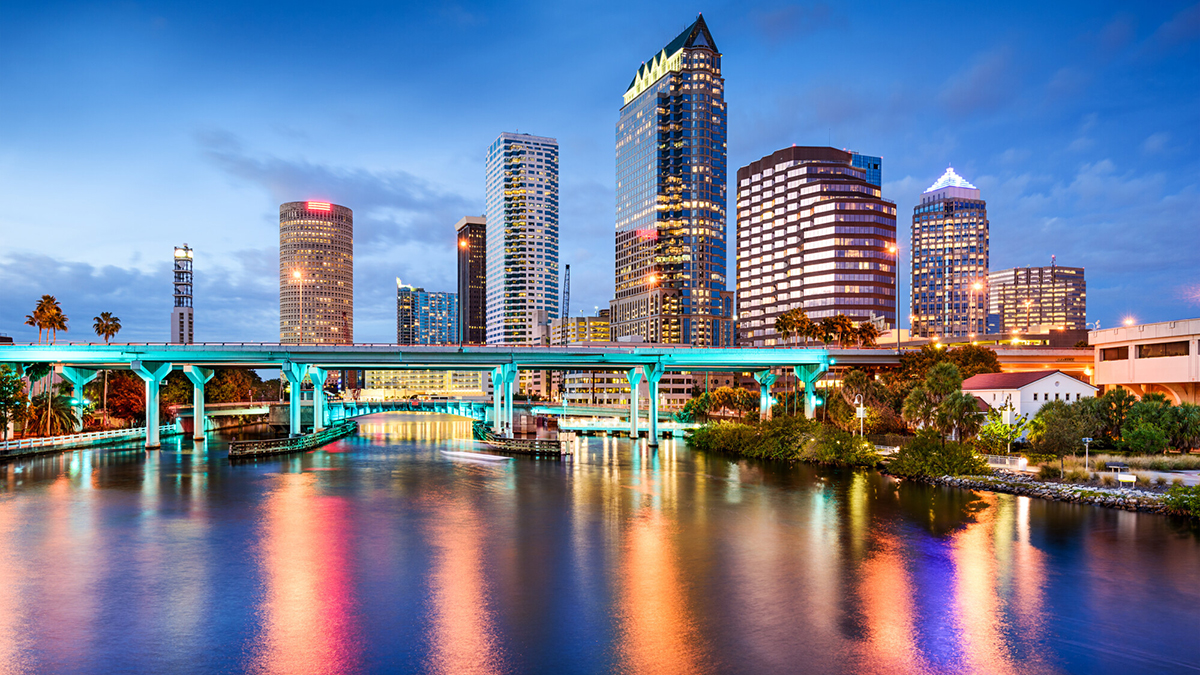
The Tampa Bay housing market is in a cooling correction in 2026, with a median sale price of approximately $443,000, homes averaging 45 to 64 days on market, and active listings up 14.8% to 25% year-over-year. The market remains competitive for entry-level buyers, but sellers now routinely accept offers roughly 2% below asking price and grant concessions, including repair credits and temporary rate buy-downs, that were rare during the 2022 peak.
Forecasters are split on what comes next. Zillow projects a modest +1.3% price rebound through the end of 2026; Realtor.com forecasts a -3.6% further decline. That divergence comes down to how each model weights mortgage rate sensitivity against inventory normalization, and the answer has direct implications for whether you should buy, sell, or wait.
This guide covers current Tampa home prices and market metrics, whether prices are still falling, the 2026 forecast and the Zillow/Realtor.com split, neighborhood price tiers from $294,000 to $1.92 million, why residents are leaving the region, the condo-specific correction, the luxury surge at the high end, and what sellers should do right now.
Housing Market
- Tampa Bay housing market overview: 2026
- Are house prices dropping in Tampa?
- What is the forecast for Tampa real estate in 2026?
- Is it a good time to buy a house in Tampa?
- Tampa Bay neighborhood prices in 2026
- Why are people moving out of Tampa Bay?
- Tampa Bay condo and townhome market in 2026
- Tampa Bay luxury home market trends
- Selling a house in Tampa’s current market
- Frequently Asked Questions
Tampa's Market Has Shifted — See What Cash Buyers Will Pay Skip 60 days on market. Compare real offers from vetted cash buyers.
No repairs, no commissions, no obligation.
Tampa Bay housing market overview: 2026
The Tampa housing market shifted decisively from a seller’s market to a buyer’s market between 2023 and 2026. Prices have pulled back from their 2022 peaks, homes are sitting longer before going under contract, and the sale-to-list price ratio has dropped below 100% for the first time in years.
Current median prices and market metrics
The table below captures the key metrics shaping the Tampa real estate market in mid-2026.
| Metric | 2026 Figure | Year-over-Year Change |
|---|---|---|
| Median sale price (Redfin) | ~$443,000 | -1.4% |
| Average home value (Zillow) | ~$380,000 | -2.1% to -4.2% |
| Avg. days on market | 45-64 days | Up from ~34 days in 2025 |
| Months of supply | 5.4-6.5 months | Up from ~2-3 months at 2022 peak |
| Sale-to-list price ratio | ~98% | Down from 101%+ in 2022 |
Redfin tracks the median sale price from completed transactions. Zillow’s average home value model includes all homes in the metro, not just recently sold ones, which explains why the two figures differ. The Greater Tampa REALTORS market report cited a single-family median of $419,995 as of early 2026, down approximately 2% year-over-year, a third data point that falls between the two national estimates.
The median home price Tampa buyers see quoted ranges from approximately $362,150 to $443,000, depending on the data source and measurement methodology. Greater Tampa REALTORS data at $419,995 falls in the middle. The spread across all three sources is more useful to buyers and sellers than any single figure.
The Tampa-St. Petersburg metro has also seen a significant rise in home inventory. Home inventory is up roughly 14.8% to 25% year-over-year through mid-2026, giving buyers options and negotiating leverage they have not had since before the pandemic.
How Tampa compares to 2022-2023 peaks
The 2022 Tampa housing market was defined by bidding wars, waived contingencies, and a sale-to-list ratio above 101%. The typical home sold in 10 to 15 days. That environment has fully reversed. Homes now sit 45 to 64 days before going under contract, and sellers routinely accept below-list offers.
The overall Tampa Bay typical home value fell approximately 6% in 2025 alone, according to Axios citing Zillow data. From the 2022 peak, prices are down an estimated 10% to 15% across the broader metro, with the condo and townhome segment declining more sharply than single-family homes.
Inventory and days on market in 2026
The rise in days on market from roughly 34 days in 2025 to 45 to 64 days in 2026 is one of the clearest signals that the market has shifted. More listings, fewer buyers at 6% to 7% mortgage rates, and longer decision timelines all extend the time a home spends on the market before going under contract.
At 5.4 to 6.5 months of supply, Tampa is operating near the 6-month threshold traditionally defined as a balanced market. In practice, buyers hold meaningful negotiating power in most submarkets, though well-priced homes in top school districts still move faster than the metro average.
Because prices have declined and the market has shifted toward buyers, the next question is whether that decline is still ongoing and how much further it might go.
Are house prices dropping in Tampa?
Yes, Tampa home prices are down 1.4% to 4.2% year-over-year in 2026, with condos and townhomes falling more sharply than single-family homes. The decline appears across every major data source, not just one provider’s estimate.
Single-family home price trends
Per-source figures for Tampa home prices as of mid-2026:
- Redfin: Median sale price $443,000, down 1.4% year-over-year (3 months ending May 2026)
- Zillow: Average home value approximately $380,000, down 2.1% to 4.2% year-over-year
- Realtor.com: Median listing price $479,000 in June 2026, down 4.17% year-over-year
- Greater Tampa REALTORS: Median $419,995, down approximately 2% year-over-year (early 2026)
- Axios (citing Zillow): Tampa Bay typical home $362,150 as of June 2025, down approximately 6% year-over-year
- 53% of active Tampa listings have had at least one price reduction, based on current data across multiple sources
According to Florida Realtors statewide price trends, Tampa’s correction is more pronounced than most Florida metros. The combination of elevated insurance costs, new construction supply, and post-hurricane migration shifts has weighed on demand more heavily here than in Orlando or Jacksonville.
Single-family home prices in the Tampa metro fell approximately 3.1% through November 2025 based on transaction data. The pace of decline has slowed into 2026, but the direction remains downward across all tracked sources.
Condo and townhome price declines
The condo market in Tampa has corrected more sharply than the single-family segment. Homebuyinginstitute.com specifically names this divergence as a distinct market dynamic, citing oversupply, rising HOA costs, and post-Surfside legislation as the primary drivers.
Price reductions in the condo segment run above the already-elevated 53% rate seen across all active listings. In several Tampa Bay submarkets, condo supply has increased to the point where buyers can negotiate not just on price but on HOA fee contributions and closing cost coverage as well.
The legislative driver is Florida Statute 718, which required condo associations to fully fund structural reserves by December 2025. Buildings that deferred maintenance are now passing large one-time assessments to unit owners, reducing the qualified buyer pool and pushing prices lower.
How much homes sell below asking price
Homes in Tampa are settling at approximately 98% of list price, meaning the average seller accepts roughly 2% below asking. On a $450,000 list price, that translates to a final sale price around $441,000.
That 2% gap is a significant behavioral shift from 2022, when homes routinely sold above list. It also means that sellers who overprice face compounding problems: 53% of active Tampa listings have already cut their price at least once, which signals to buyers that the original ask was unrealistic and extends days on market further.
Because prices are falling and seller leverage has eroded, the central question is whether the decline will continue, stabilize, or reverse. This is where forecasters disagree most sharply.
What is the forecast for Tampa real estate in 2026?
The Tampa housing market forecast for 2026 is genuinely contested, with two major models pointing in opposite directions. Zillow projects a +1.3% modest price rebound; Realtor.com projects a -3.6% further decline. Understanding why they diverge matters more than picking one number.
Zillow vs. Realtor.com: two diverging forecasts
| Source | 2026 Price Direction | Key Driver Cited |
|---|---|---|
| Zillow | +1.3% modest rebound | Inventory stabilization |
| Realtor.com | -3.6% further decline | Elevated mortgage rates + high supply |
| Homebuyinginstitute.com | Continued decline through at least Q1 | Tampa fell 6% in 2025 |
| Fox13 / national forecasters | Top-10 metro for expected price dip | Regional overbuilding + insurance costs |
| Most local analysts | Flat to mild correction | Buyer’s market conditions through late 2026 |
Neither forecast constitutes financial or investment advice. Consult a licensed real estate professional before making a purchase or sale decision in Tampa Bay.
Why the two models diverge: Zillow’s model weights recent transaction velocity and inventory normalization. When the pace of new listings slows and price cuts moderate, Zillow’s algorithm reads that as stabilization and projects a mild recovery. Realtor.com’s model places heavier emphasis on mortgage rate sensitivity and the volume of overpriced listings still cycling through the market. At 6% to 7% mortgage rates, affordability remains stretched, and Realtor.com treats that as a continued drag on buyer demand. Neither model signals a crash. The disagreement is about the degree of further softening.
For buyers, the Realtor.com scenario means waiting until late 2026 could yield an additional 3% to 4% price reduction. For sellers, the Zillow scenario means listing sooner captures the floor before a modest recovery begins. Most local analysts characterize the Tampa housing market forecast for 2026 as flat to a mild correction, not a crash or a rebound.
New construction supply and its effect
New construction is one of the primary forces keeping supply elevated in the Tampa real estate market. The FHFA House Price Index for Tampa-St. Petersburg confirms the metro has seen sustained price softening tied in part to new builds competing directly against resale inventory.
| Submarket | Construction Momentum | Effect on Supply |
|---|---|---|
| Manatee County | Permits increased significantly in 2025 | Adding new units to already-elevated inventory |
| Tampa city proper | Residential permits rising in 2025 | Competing with resale inventory |
| Pinellas County | Slower new-build pace | Population decline reducing absorption pressure |
Source: permit trend data per shovels.ai (2025 figures); verify against FHFA HPI data at publish.
Understanding why builder price cuts have been limited requires looking at construction economics. Even as permits rise, construction costs remain elevated, compressing margins and limiting how much builders can discount to move units. For the full cost picture in Hillsborough County and beyond, see our guide on Florida construction costs.
Because new construction supply competes with resale inventory across the metro, sellers must price against both existing homes and new builds offering builder incentives.
Mortgage rate scenarios for Tampa buyers
Mortgage rates in the 6% to 7% range through mid-2026 remain the single biggest affordability constraint for financed buyers in the Tampa housing market. At a 6.5% rate on a $443,000 purchase with 10% down, the monthly principal and interest payment is approximately $2,670. At the 2022 peak rate of 3.5%, the same home cost roughly $1,790 per month. That $880 monthly difference explains why buyer demand remains constrained even at prices well below peak.
If rates decline toward 5.5% to 6% in late 2026 or 2027, affordability improves materially and buyer demand likely returns. That rate-decline scenario is the central assumption underpinning Zillow’s modest rebound forecast.
Is it a good time to buy a house in Tampa?
Buying in Tampa in 2026 is reasonable if you plan to hold the property for at least five years, with prices off their 2022-2025 peaks, inventory at multi-year highs, and bidding wars fully cooled. The Tampa real estate market offers genuinely favorable buyer conditions right now, but it is not a once-in-a-generation buying opportunity. Negotiating conditions are simply the most favorable since 2019.
Months of supply and negotiating power
At 5.4 to 6.5 months of supply, Tampa is operating at or just above the traditional buyer’s market threshold of six months. That level of months of supply gives buyers options they have not had in years: more homes to choose from, fewer competing offers, and sellers motivated to deal.
Tampa’s supply sat at roughly 2 to 3 months at the 2022 peak. A buyer going under contract in 2022 competed against multiple offers and often waived inspection contingencies. The same buyer in 2026 typically has days to make a decision and can request a home inspection, an appraisal contingency, and a closing cost contribution without losing the deal.
What buyers can negotiate right now
Sellers in the current Tampa housing market are routinely offering:
- Repair credits for items flagged in the inspection report
- Closing cost contributions (typically 2% to 3% of purchase price)
- Temporary mortgage rate buy-downs (covering the first 1 to 2 years at a lower rate)
- Price reductions on homes that have already sat 60 or more days on the market
These concessions were rare during the 2022 peak. A buyer who uses them effectively can reduce the effective purchase cost or monthly payment materially beyond what the stated list price implies.
Risks buyers should still consider
The case for buying in Tampa carries real risk. According to the Freddie Mac Primary Mortgage Market Survey, rates remain elevated, meaning monthly payments are high relative to income for most buyers.
Additional risks to weigh:
- Price may fall further. Realtor.com forecasts an additional 3.6% decline through 2026. A buyer who purchases at $443,000 today could see the same home worth roughly $427,000 by year-end under this scenario.
- Homeowner’s insurance costs. Florida’s average homeowner’s insurance premium reached approximately $15,460 per year by end of 2025. That adds roughly $1,288 per month to carrying costs, on top of the mortgage payment.
- Hurricane risk. Consecutive storm seasons, including Helene and Milton, have accelerated insurance cost increases and added real downside risk to properties in low-lying or coastal areas.
- Condo-specific risk. The condo market carries additional volatility due to Florida’s HOA reserve legislation. The dedicated section below explains the mechanics.
Because total cost of ownership extends well beyond the list price, the decision to buy depends heavily on how long you plan to hold the property.
Tampa Bay neighborhood prices in 2026
Tampa home prices vary dramatically by neighborhood, from under $300,000 in East Tampa to nearly $2 million on Davis Islands. The table below spans the full price range across the Tampa Bay market in 2026.
| Neighborhood | Estimated Median (2026) | Market Tier |
|---|---|---|
| Davis Islands | ~$1.92M | Ultra-premium |
| Harbour Island | $1M+ | Luxury |
| Southwest Tampa | ~$836K | Upper mid-range |
| Palma Ceia | High $600s-$800s | Upper mid-range |
| North Hyde Park | Mid-$400s-$600s | Mid-range |
| Tampa metro overall | ~$443,000 | Market baseline |
| 40th Street Corridor | ~$294K | Most affordable |
The Davis Islands ($1.92M), Southwest Tampa ($836K), and 40th Street Corridor ($294K) figures come from the Google AI Overview verbatim. All neighborhood medians should be confirmed against current tamparealtors.org neighborhood reports before transacting.
Most expensive Tampa Bay zip codes
Davis Islands is the most expensive market in Tampa Bay, with a median home price of approximately $1.92 million in 2026. The neighborhood sits on a manmade island in Hillsborough Bay, directly south of downtown, and its waterfront positioning drives pricing well above the metro median.
Southwest Tampa follows at a median around $836,000. Harbour Island, positioned between downtown and Davis Islands, runs above $1 million. Palma Ceia rounds out the premium tier in the high $600,000 to $800,000 range.
These premium urban zip codes have remained highly expensive even as broader Tampa home prices have declined. The buyer pool for luxury real estate in these submarkets is dominated by out-of-state cash buyers who are not constrained by mortgage rate levels, which insulates these neighborhoods from the correction seen in entry-level and mid-range markets.
Mid-range and emerging neighborhoods
North Hyde Park sits in the mid-range of the Tampa market, with medians in the mid-$400,000 to $600,000 range. These neighborhoods offer proximity to Midtown Tampa, the Riverwalk, and major employment corridors while remaining $50,000 to $200,000 below Palma Ceia or South Tampa price points.
Emerging neighborhoods in East Tampa and the Seminole Heights area represent options for buyers willing to trade walkability and school ratings for a lower entry price. These submarkets have seen more price reductions than premium neighborhoods, and days on market run longer on average.
Most affordable areas in Tampa Bay
The 40th Street Corridor is Tampa’s most affordable market in 2026, at a median of approximately $294,000, roughly $150,000 below the metro median. East Tampa broadly offers entry-level options under $350,000 in several zip codes.
These affordable areas are where first-time buyers most often compete, and where buyer’s market conditions are most pronounced. Sellers here face the most pressure to price realistically, as buyer options are plentiful and financing constraints limit the pool to those who qualify at current rates.
Why are people moving out of Tampa Bay?
People are leaving Tampa Bay primarily because of soaring insurance costs (averaging approximately $15,460 per year), home prices that rose 60% since 2020, and hurricane exposure from consecutive damaging storm seasons.
Insurance costs and hurricane exposure
The five main drivers behind Tampa Bay’s outbound migration:
- Insurance costs: Florida’s average homeowner’s insurance premium reached approximately $15,460 per year by end of 2025, among the highest in the nation, according to Florida Office of Insurance Regulation premium data. That figure adds over $1,200 per month to housing costs on top of the mortgage payment.
- Home price appreciation: Tampa home prices rose roughly 60% since 2020, outpacing wage growth and pushing cost-burdened households toward lower-cost metros.
- Hurricane risk: Consecutive storm seasons, including Helene and Milton, accelerated departures from high-risk coastal and low-lying areas. Hurricane risk perception has shifted the long-term residency calculus for many households across the region.
- HOA fee increases: Condo owners in older buildings face mandatory special assessments tied to Florida’s reserve funding law passed after the 2021 Surfside collapse.
- Wage stagnation: Nearly half of Hillsborough County and Pinellas County households are cost-burdened, with housing cost growth outpacing local wage gains.
Housing affordability vs. local wages
According to U.S. Census Bureau Pinellas County population estimates, Pinellas County experienced approximately 12,000 residents in net population decline between 2024 and 2025, one of the largest county-level drops in the nation during that period.
The affordability squeeze is most acute in Hillsborough County and Pinellas County, where local wages have not kept pace with housing cost increases from 2020 through 2025. A household earning the Tampa area median income can afford significantly less home today than in 2019, even with the current price correction, because elevated mortgage rates add carrying cost that price declines have only partially offset.
Tampa was named among the top-20 cities people are leaving in a May 2025 PODS study, indicating that outbound migration predates the most recent storm seasons and is rooted in structural affordability challenges.
Where residents are relocating
Migration data from Redfin shows Tampa Bay receives significant inbound migration from New York, Chicago, and other high-cost metros. Outbound migration skews toward Orlando and lower-cost Florida markets, as well as Southeast metros where housing costs remain more aligned with local wages.
| Inbound to Tampa | Migration Pattern | Outbound from Tampa |
|---|---|---|
| New York City | High net inflow | Orlando |
| Chicago | Moderate net inflow | Jacksonville |
| Northeast / Midwest metros | Steady inflow | Lower-cost Southeast metros |
Source: Redfin migration data, 2025-2026.
The net result is that Tampa still attracts high-income remote workers and retirees from expensive coastal markets while losing middle-income residents to more affordable Florida cities. This bifurcation helps explain why luxury real estate has remained strong while entry-level and mid-range segments have corrected sharply.
Because out-of-state cash buyers drive the luxury segment while financed buyers constrained by 6% to 7% rates drive the rest of the market, the type of buyer your home attracts matters as much as the list price.
Tampa Bay condo and townhome market in 2026
The condo market in Tampa Bay has corrected more sharply than the single-family segment in 2026, driven by oversupply, higher carrying costs, and a specific piece of Florida legislation that changed the financial obligations of condo owners statewide.
Why condo prices fell harder than houses
Homebuyinginstitute.com specifically identifies the Tampa Bay condo and townhome correction as a distinct phenomenon from the broader price decline. Three factors explain the divergence:
- Supply glut. Certain Tampa Bay submarkets, particularly in St. Petersburg and along the waterfront, accumulated condo inventory faster than demand could absorb it. When the buyer pool narrowed due to rising insurance and HOA costs, the required price adjustment was steeper than in the single-family segment.
- Higher carrying costs. A condo buyer pays not just the mortgage but also HOA fees, special assessments, and condo insurance. As all three have risen, the effective monthly cost of owning a Tampa condo has increased even as list prices have fallen.
- Financing complications. Some Tampa Bay condo buildings have failed to meet Fannie Mae and Freddie Mac lending criteria due to deferred maintenance or underfunded reserves. When a building cannot secure conventional financing, the buyer pool shrinks to cash purchasers only, pushing prices lower.
Surfside legislation and HOA fee hikes
Florida Statute 718 was passed in 2022 following the June 2021 Surfside building collapse. The law required condo associations to fully fund structural reserves by December 2025. Buildings that deferred maintenance for years now face mandatory special assessments to bring reserves into compliance.
These assessments can run tens of thousands of dollars per unit in older buildings, reducing the pool of qualified buyers who can absorb both a purchase price and a large immediate assessment. The result is concentrated downward price pressure in buildings constructed before 2000.
Condo buying risks and opportunities
According to Bureau of Labor Statistics Tampa metro employment data, Tampa’s job market remains relatively healthy, which means the condo correction is not the result of a recessionary demand collapse. It is supply-driven and cost-driven, which creates a genuine buying opportunity for investors with a 5 to 10 year horizon, once excess supply clears and HOA financials stabilize in buildings that have completed their reserve funding compliance.
Buyers considering Tampa condos should:
- Request the most recent reserve study and engineering report before making an offer
- Review the last 12 months of HOA board meeting minutes for pending assessments
- Confirm whether the building qualifies for conventional Fannie Mae or Freddie Mac financing
- Budget for potential special assessments beyond the stated purchase price
Tampa Bay luxury home market trends
The luxury segment of the Tampa Bay real estate market is moving in the opposite direction from the broader market. While entry-level and mid-range prices have declined 2% to 6% year-over-year, the $1.5 million-and-above segment is growing, driven by an influx of affluent out-of-state buyers.
According to NAR data on luxury and all-cash home sales, all-cash transactions have become a larger share of high-end home sales nationally, and Tampa’s luxury market reflects this trend.
Luxury price growth by Tampa zip code
Bay News 9 reported that Tampa leads the nation in luxury home price growth in 2026, a finding echoed by QZ.com analysis of metros where luxury prices are growing fastest. Davis Islands, with a median of approximately $1.92 million, is the primary driver of this growth.
The luxury real estate bifurcation is visible at the zip code level:
- Davis Islands: Median approximately $1.92M, driven by waterfront single-family homes with direct bay access
- Harbour Island: Median above $1M, supported by walkability and proximity to downtown Tampa
- Southwest Tampa / Palma Ceia: Medians in the $700,000 to $836,000 range, with premium lots frequently above $1M
Premium urban zip codes remain highly expensive even as the broader Tampa Bay real estate market corrects. The structural difference is the buyer: luxury buyers are predominantly out-of-state cash buyers from California, New York, and other high-cost coastal markets where Tampa prices look relatively modest at $1.5M to $2M.
Out-of-state cash buyer activity
The luxury surge in Tampa Bay real estate is not driven by local demand. It is fueled by affluent out-of-state cash buyers who relocated from more expensive coastal markets and are purchasing with equity rather than financing. For these buyers, a 6% to 7% mortgage rate is largely irrelevant.
This dynamic insulates the luxury segment from the affordability constraints depressing entry-level and mid-range demand. Luxury price trends are not a reliable signal for what entry-level or mid-range buyers should expect. The two segments operate on fundamentally different supply and demand dynamics.
Selling a house in Tampa’s current market
Selling in Tampa in 2026 is achievable, but the numbers require honest planning. Homes sit 45 to 64 days on market, settle approximately 2% below asking, and 53% of active listings have already cut their price at least once. A seller who plans around current data can close successfully; a seller expecting 2022-era conditions will be disappointed.
Pricing strategy in a buyer’s market
The single most common mistake Tampa sellers make right now is overpricing at list. When a home sits 30 or more days without an offer, buyers read the stale listing as a signal that something is wrong, even when the only issue is price. Multiple price reductions compound this perception and typically yield a lower final sale price than an accurate initial price would have produced.
Practical pricing guidance for 2026:
- Price at or just below the most recent comparable sales, not 2022-2025 peak comps
- Account for the 2% below-list settlement norm when setting expectations for net proceeds
- Time to the spring market. Tampa’s strongest selling window historically runs March through May, when buyer activity peaks. For a detailed look at Tampa’s seasonal patterns, see our Tampa selling season guide.
How to reduce days on market in Tampa
Every additional week on market in the current Tampa housing market increases the likelihood of a price reduction and decreases the final sale price. The steps most effective at reducing days on market:
- Professional photography and staging. Homes with professional photos receive more showings, generating competitive pressure even in a buyer’s market.
- Pre-listing inspection. A pre-listing inspection removes the most common reason contracts fall apart (inspection surprises) and gives buyers confidence to move quickly.
- Competitive concession structure. Offering a closing cost contribution upfront, rather than waiting for buyers to ask, removes a common negotiation delay.
- Accurate list price from day one. The earlier a seller accepts current market reality in pricing, the fewer days the home spends on market.
For a step-by-step approach to selling in Tampa’s current environment, the Tampa home sale guide covers preparation, pricing, and closing in detail.
When a cash offer makes sense in Tampa
The traditional Tampa sale in 2026 runs approximately 45 to 64 days on market plus a 30 to 45 day financed closing, for a total of roughly 90 to 110 days from list to close. A cash offer closes in 7 to 30 days.
Cash buyers are a meaningful part of the Tampa market, particularly at the entry-level and luxury ends. For sellers managing an estate, a relocation, or a property that needs repairs they cannot fund upfront, a competitive cash offer eliminates months of carrying costs and deal-fall risk. The tradeoff is that cash offers typically come in below what a retail financed buyer might pay on the open market. You can compare offers from Florida cash home buyers to see what the market will actually pay in cash before committing to a listing.
If you’re selling in Tampa’s current market, the timeline matters as much as the list price. The average listing sits 45 to 64 days before going under contract, then closes another 30 to 45 days after that. A competing cash offer through iBuyer.com compresses that to 7 to 30 days total, with no agent commission, no repair requirements, and no risk of a financed buyer walking over an appraisal gap. Submit your Tampa home’s address and condition details, receive multiple offers from vetted cash buyers, and compare them side by side before committing to anything. For sellers who need certainty over timing, it is worth seeing what the market will actually pay in cash before locking into a listing that may take months to close.
[Get competing cash offers for your Tampa home]
Sell Your Tampa Home on Your Timeline Homes sit 45-64 days on the MLS. Cash offers close in 7-30.
Multiple offers, zero repairs, close when you're ready.
Frequently Asked Questions
Yes, Tampa home prices are down 1.4% to 4.2% year-over-year in 2026, with condos and townhomes falling more sharply than single-family homes. Redfin tracks a median sale price of $443,000, down 1.4% year-over-year. Zillow’s average home value sits at approximately $380,000, down 2.1% to 4.2% depending on the measurement period. 53% of active Tampa listings have had at least one price reduction, and homes consistently settle around 2% below asking price.
The median sale price in Tampa is approximately $443,000 as of mid-2026, while Zillow’s average home value model tracks lower at around $380,000. The gap exists because Redfin’s median counts completed transactions, while Zillow models all homes in the metro including those not recently sold. Greater Tampa REALTORS reported a single-family median of $419,995 in early 2026, a third data point that falls between the two national estimates.
Tampa Bay is a buyer’s market in 2026, with 5.4 to 6.5 months of housing supply and homes selling consistently below asking price. A market with more than 6 months of supply is generally defined as a buyer’s market. Tampa buyers now have more negotiating leverage than at any point since 2019, including room to request repair credits, temporary mortgage rate buy-downs, and closing cost contributions from sellers.
Homes in Tampa sit on the market an average of 45 to 64 days in 2026, up from roughly 34 days a year earlier. Luxury listings in premium zip codes like Davis Islands may move faster; condos in oversupplied submarkets can sit longer. Both figures represent a dramatic shift from the 10 to 15 day average seen at the 2022 market peak.
It is a reasonable time to buy in Tampa in 2026 if you plan to hold the property for at least five years, with prices off their 2022-2025 peaks and inventory at multi-year highs. Buyers currently have more options, fewer competing offers, and sellers willing to negotiate concessions. The key risk is that Realtor.com forecasts an additional 3.6% price decline through 2026, and mortgage rates remain in the 6% to 7% range, limiting monthly affordability.
Forecasters are divided: Zillow predicts a modest +1.3% price rebound in Tampa through 2026, while Realtor.com forecasts a -3.6% further decline. The divergence comes from methodology: Zillow’s model weights recent transaction velocity and inventory normalization, while Realtor.com emphasizes mortgage rate sensitivity and overpriced listings still cycling through the market. Most local analysts characterize the Tampa housing market forecast as flat to a mild correction for 2026, not a crash or a rebound.
People are leaving Tampa Bay primarily because of soaring homeowner’s insurance costs averaging approximately $15,460 per year, home prices that rose 60% since 2020, and hurricane exposure from consecutive damaging storm seasons. Pinellas County lost approximately 12,000 residents between 2024 and 2025, one of the largest county-level population declines in the nation during that period. Condo owners face additional pressure from mandatory HOA reserve funding requirements tied to Florida’s post-Surfside legislation.
The 40th Street Corridor is Tampa’s most affordable area in 2026, with a median home price of approximately $294,000. Other relatively affordable submarkets include East Tampa and parts of North Tampa outside premium school districts. The $294,000 figure sits roughly $150,000 below the metro-wide median, making it the primary entry point for first-time buyers.
Davis Islands is Tampa’s most expensive neighborhood in 2026, with a median home price of approximately $1.92 million. Southwest Tampa follows at a median around $836,000. Both areas are insulated from the broader market correction because demand is driven primarily by out-of-state cash buyers who are not constrained by mortgage rate levels.
Tampa home prices are down roughly 10% to 15% from the 2022 peak, with the overall metro down approximately 6% in 2025 alone. The typical Tampa Bay home reached approximately $362,150 in June 2025, compared to peak estimates above $420,000 to $440,000 for comparable properties. The condo and townhome segment fell more sharply than single-family; luxury properties above $1.5 million have not declined meaningfully from peak levels.
Tampa’s correction has been steeper than most Florida metros, with prices down 2% to 4% year-over-year while Miami and Orlando have experienced softer declines. Tampa was named among the top-10 metros nationally expected to see home price declines in 2026, a distinction not applied to Miami or Jacksonville. The combination of hurricane risk, elevated insurance costs, and above-average new construction supply has made the Tampa Bay real estate correction more pronounced than the statewide average.
Tampa condos carry higher financial risk in 2026 than single-family homes, primarily because of mandatory HOA reserve funding requirements driving special assessments across older buildings. Florida Statute 718, passed in 2022 after the Surfside building collapse, required condo associations to fully fund structural reserves by December 2025. Buyers considering Tampa condos should request the most recent reserve study, engineering report, and association meeting minutes before making an offer, and budget for potential special assessments beyond the stated purchase price.
Most forecasters expect Tampa’s market to stabilize into 2027 with flat to modest price growth, assuming mortgage rates ease below 6.5% and insurance costs do not spike further. The current correction is supply-driven, not a financial-crisis-driven crash, and price support should return as elevated inventory is absorbed and new construction slows in response to lower margins. The most significant risk to a 2027 recovery is another active hurricane season that accelerates outbound migration and extends the buyer’s market.
Selling in Tampa in 2026 is achievable, but sellers should expect 45 to 64 days on market and a final sale price roughly 2% below list. Overpricing is the most common seller mistake in the current market, with 53% of active Tampa listings having already taken at least one price cut. Sellers who need to close quickly or want to avoid contingency-heavy financed offers may find competing cash offers through a marketplace the faster alternative to a traditional listing.

Reilly Dzurick is a licensed real estate agent with over six years of experience and a member of the iBuyer.com Market Insights Team, covering national trends in home selling and the evolving iBuyer landscape. Her firsthand experience working with buyers and sellers gives her a practical perspective on how these platforms impact real homeowners. She holds a degree in Public Relations, Advertising, and Applied Communication.