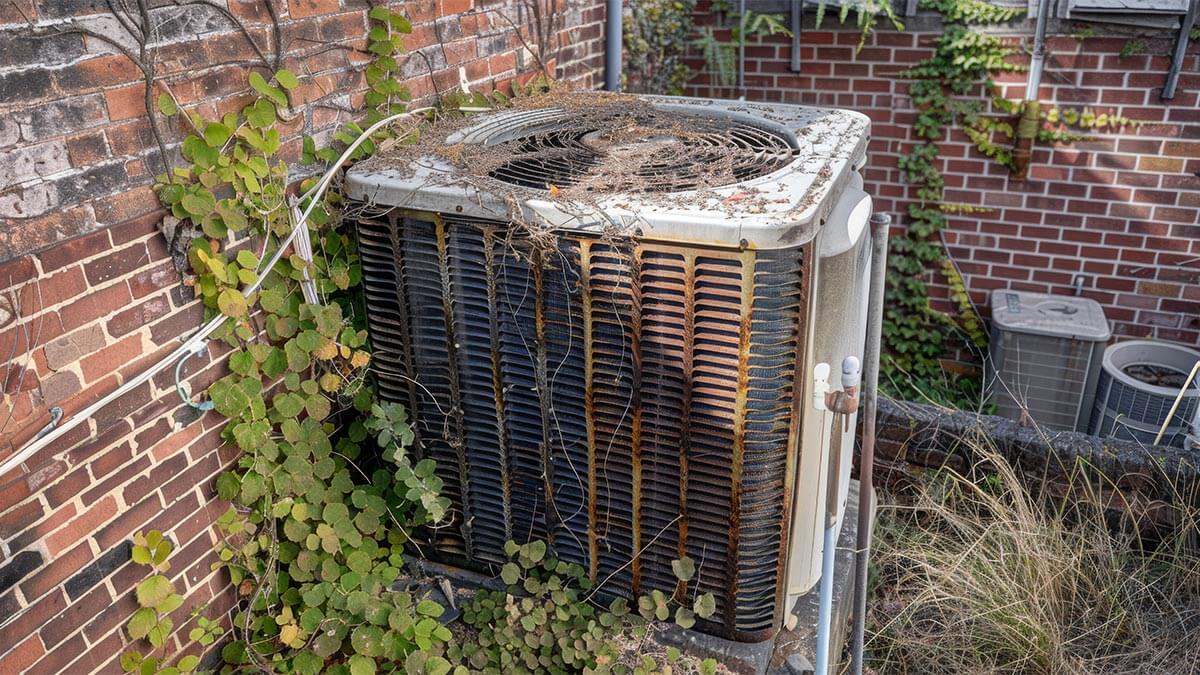
In most cases, you should not replace your HVAC before selling, if the system is operational, a repair credit at closing typically puts more money in your pocket than absorbing a $6,000 to $12,000 replacement upfront. Pre-sale HVAC replacement returns 35% to 85% of its cost at best, which means you spend $10,000 and recover $3,500 to $8,500 in added value, while a $2,000 to $5,000 repair credit costs you far less and transfers the decision to the buyer.
Three conditions change that math: the system is non-functional, it poses a safety hazard, or it will derail FHA or VA financing. Outside those triggers, the better move is almost always to disclose, tune up, and negotiate.
This guide covers when replacement actually makes sense, how to apply the $5,000 rule HVAC formula, how to compare replacement against a closing concession, what HVAC age does to your asking price, and how to sell a house with an old HVAC system without replacing a thing.
Replace HVAC
- Should You Replace HVAC Before Selling Your House?
- What Is the $5,000 Rule for HVAC?
- Replace Before Listing vs. Offer a Concession at Closing
- How HVAC Age Affects Your Asking Price
- What to Do Instead of Replacing HVAC Before Selling
- What Not to Fix Before Selling Your House
- Selling a House With an Old or Failing HVAC As-Is
- Frequently Asked Questions
Sell As-Is, Skip the HVAC Bill Cash buyers purchase your home regardless of system age — no repair credits required.
No repairs, no agent fees, no obligations.
Should You Replace HVAC Before Selling Your House?
Usually, no, but three specific conditions change that calculus. If your HVAC is operational and passes a basic safety check, replacement rarely returns dollar-for-dollar at resale. According to HVAC lifespan and buyer appeal research, most central HVAC systems last 15 to 20 years with proper maintenance, and buyers consistently factor remaining useful life into their offers rather than demanding a brand-new system.
NAR cites approximately 85% ROI for heating and cooling system replacement in favorable market conditions, that is the high-end figure. The more typical range cited across aggregated market sources is 35% to 60%. Homes with newer systems can sell 10 to 11 days faster, and buyers may offer 2% to 5% more. Whether those benefits offset a $6,000 to $12,000 installation cost depends entirely on your specific system, buyer pool, and market.
When replacement is the right call
Replace your HVAC before listing if any of the following apply:
- The system is non-functional. A dead system is a deal-breaker for nearly every buyer and will generate an immediate repair demand after inspection.
- There is a documented safety hazard. Cracked heat exchangers, carbon monoxide risks, or fire hazards require remediation regardless of your sale timeline.
- Your expected buyers need FHA or VA financing. FHA and VA loans require the system to heat and cool adequately. A system that cannot meet that threshold will trigger a repair requirement before closing. Age alone is not the standard, operability is.
- The system is 20-plus years old and showing failure symptoms. At that age, combined with repair needs that clear the $5,000 rule threshold (see H2 2 below), replacement may generate more buyer confidence than a disclosed-and-credited old unit.
- Your local market is competitive and buyers expect turnkey homes. In some price brackets and metros, an aging HVAC is a legitimate negotiating anchor buyers use to drive your price down more than a replacement would cost.
When to skip replacement and negotiate instead
Skip replacement and offer a repair credit or price reduction if:
- The system is operational and heats and cools adequately
- The system is under 15 years old
- The $5,000 rule calculation (below) comes out under the threshold
- Your buyers are using conventional financing with no HVAC operability contingency
- You have maintenance records documenting service history
This is the scenario most sellers face. The right response is a tune-up, documentation, and a disclosed condition, not a $10,000 system swap that you recover at 35% to 60%.
What Is the $5,000 Rule for HVAC?
The $5,000 rule is a repair-or-replace decision guideline: multiply your HVAC system’s age in years by the estimated repair cost in dollars. If the result is $5,000 or more, replacement is generally more cost-effective than repair. If the result is under $5,000, repair.
This formula, covered by the $5,000 HVAC repair-or-replace guideline, gives sellers and homeowners a fast numeric threshold without needing an engineering assessment. It works best when paired with a licensed HVAC technician’s written condition report.
How to calculate your HVAC decision number
The formula:
System age (years) × estimated repair cost ($) = decision number
- Decision number at or above $5,000: lean toward replacement
- Decision number below $5,000: repair is likely the better financial move
Worked example: 12-year-old unit, $500 repair
- Scenario A: 12-year-old unit × $500 repair = $6,000 → exceeds $5,000 threshold → replacement is the stronger financial call
- Scenario B: 8-year-old unit × $500 repair = $4,000 → below threshold → repair and disclose
- Scenario C: 6-year-old unit × $300 repair = $1,800 → well below threshold → repair without hesitation
In Scenario A, the system is in the back half of its expected lifespan and the repair cost is meaningful. A new system adds buyer confidence and removes a likely negotiating point. In Scenario B and C, repair preserves your cash and the system still has useful life for the next owner.
Note: some sources describe the $5,000 rule as a straight repair-cost cap (if the repair itself costs more than $5,000, replace). The multiplication version above, age × repair cost, is the more precise formulation because it accounts for diminishing return on repairing aging equipment.
Replace Before Listing vs. Offer a Concession at Closing
The real financial decision is not “old vs. new HVAC”, it is “replace upfront vs. negotiate a credit.” Here is how those two paths (plus a third: selling as-is) compare across the metrics that matter to sellers.
| Factor | Replace Before Listing | Repair Credit at Closing | Sell As-Is |
|---|---|---|---|
| Upfront cost | $6,000 to $12,000 | $0 | $0 |
| Net proceeds impact | Recover 35% to 85% of cost | Credit reduces price by $2,000 to $5,000 | Price reflects condition; buyer absorbs cost |
| Buyer negotiating leverage | Low, new system removes objection | Moderate, credit is documented | Minimal post-offer negotiation if priced correctly |
| Time to close | Adds 1 to 3 weeks for installation | No delay | Fastest path, often 7 to 30 days |
| Inspection risk | Eliminated | Remains unless waived | Buyer accepts condition as-is |
| FHA/VA financing impact | Fully compliant | Compliant only if system is operable | May not be compatible with FHA/VA |
| Out-of-pocket stress | High, you manage the project | Low | None |
Based on aggregated market data, 2026. Verify replacement costs with local HVAC contractors before transacting.
What a repair credit or price reduction looks like
A repair credit is a dollar amount you agree to credit the buyer at closing, reducing what they owe or funding their post-close repair. Credits typically run $2,000 to $5,000 for aging HVAC systems, depending on the system’s age, local replacement costs, and how motivated each side is to close.
A price reduction works the same way from a net-proceeds standpoint but is visible in your listing history. Credits are negotiated in the purchase agreement and stay off the MLS.
For most sellers, the credit path is cleaner: you list at full price, field offers, and negotiate the credit as part of the final contract. You keep control of the number and avoid the disruption of a pre-listing installation.
Which option nets you more money
According to HVAC efficiency benchmarks show that modern high-efficiency systems do command buyer interest, but “buyer interest” and “higher net proceeds after your upfront cost” are different things. When you replace a $10,000 system and recover $6,000 to $8,500 in added value, your net gain is negative $1,500 to negative $4,000. When you offer a $4,000 credit, your net loss is exactly $4,000, and you did no installation work.
The credit wins in most scenarios unless your market is highly competitive and the system is genuinely non-functional.
How HVAC Age Affects Your Asking Price
HVAC age home value is a real factor in appraisals and buyer negotiations, not just a theoretical concern. Buyers, appraisers, and inspectors all assign different weight to system age depending on where it falls in the expected lifespan.
HVAC age ranges buyers and appraisers use
According to data on HVAC condition and buyer decision-making, systems in different age brackets generate different buyer responses:
| System Age | Typical Buyer Response | Appraiser Treatment |
|---|---|---|
| Under 5 years | Neutral to positive; recent replacement is a selling point | Full remaining value credited |
| 5 to 10 years | No concern in most markets | Standard depreciation |
| 10 to 15 years | Buyers begin factoring future replacement cost into offers | Noted; no automatic deduction |
| 15 to 20 years | Commonly flagged; buyers request credits or price reductions | May note as approaching end of life |
| 20-plus years | Significant negotiating point; FHA/VA scrutiny increases | Flagged as deferred maintenance |
Based on home inspection industry guidance, 2026.
The hvac system lifespan benchmark of 15 to 20 years is the clearest dividing line. Before 15 years, an operational system is unlikely to generate a buyer walkaway. After 20 years, you should expect a credit request even if the system runs perfectly.
How inspectors flag aging systems
Home inspectors do not “fail” HVAC systems based on age alone. They assess whether the system operates, whether it heats and cools adequately, and whether any safety concerns are present. A 20-year-old system that runs properly may receive language like “approaching end of useful life, budget for replacement” without triggering a mandatory repair requirement.
FHA and VA HVAC requirements are similarly misunderstood. The standard for fha va hvac requirements is operability and safety, not age. FHA Minimum Property Standards require a heating system capable of maintaining at least 50°F in living areas. A VA appraisal requires the system to be in safe operating condition. Neither program specifies a maximum system age. A 22-year-old furnace that heats reliably and safely will pass both, a 5-year-old unit with a cracked heat exchanger will not.
This is where many sellers over-invest. If your aging system passes a technician’s operational check and heats and cools to code, replacement is not required for home inspection hvac purposes or for government-backed financing.
What to Do Instead of Replacing HVAC Before Selling
The alternative to replacement is not “do nothing.” Sellers who skip replacement and want to minimize buyer objections have three concrete actions: service the system, document its history, and disclose accurately.
Service and tune-up: what it costs and what it fixes
An HVAC tune-up costs $75 to $200 and covers filter replacement, coil cleaning, refrigerant level check, thermostat calibration, and a general operational assessment. Following HVAC service standards, a professionally serviced system is demonstrably less likely to generate post-inspection repair demands than an unserviced one, even when both units are the same age.
The hvac tune-up cost is roughly 1% to 3% of what a full replacement costs, and it produces a service receipt that you can show buyers. A $150 tune-up that generates a clean bill of health from a licensed technician removes the single biggest source of buyer anxiety about an aging system.
Pre-sale home repairs at the tune-up and minor-fix level almost always deliver better return on investment home repairs than major system replacements, because the cost is low and the buyer-confidence impact is real.
Gather maintenance records before you list
If you have had the system serviced annually, pull those records together before listing. Buyers who see a 15-year-old unit with five years of documented service history are far less likely to demand a credit than buyers who see an identical system with no records.
If you do not have records, the tune-up receipt from step one becomes your starting documentation. Some sellers also request a written statement from the HVAC technician confirming the system is operational and its estimated remaining life, that document supports both your disclosure and your negotiating position.
For sellers considering selling a house in poor condition, this documentation step still applies: even in an as-is sale, accurate condition records reduce post-offer renegotiation.
Disclosure language that protects you
Seller disclosure hvac requirements exist in nearly every state. You are generally required to disclose known material defects, and HVAC condition qualifies as material. Proper disclosure does not mean you must fix the problem, it means you must accurately describe what you know.
Disclosure language typically covers: system age, last service date, any known issues or repair history, and whether the system currently heats and cools adequately. Sellers in Michigan and other states with specific disclosure forms should use the state’s official form verbatim. For state-specific guidance on distressed home sales in Michigan, including disclosure obligations, see the local market guide.
Sellers who want to avoid the disclosure negotiation entirely can sell as-is to a cash buyer, covered in H2 7 below.
What Not to Fix Before Selling Your House
The principle behind “what not to fix” is ROI discipline: if a repair costs more than it returns in offer price, you are effectively paying for the next buyer’s home improvement budget. HVAC replacement is one of many items that frequently falls into this category, but it is not alone.
Cosmetic repairs with low ROI
Skip or minimize:
- Fresh paint in non-neutral colors. Painting in a color the buyer will repaint anyway returns almost nothing. Neutral paint in worn rooms is worth it; full exterior repaints rarely pencil out.
- Carpet replacement. Buyers often prefer to select their own flooring. Replacing worn-but-safe carpet before listing may yield a lower return than a flooring credit.
- Landscaping upgrades. Tidying and maintaining is worth the effort; installing new hardscaping or irrigation rarely returns its cost.
- Fixture swaps in functional kitchens and baths. New faucets and light fixtures cost $500 to $2,000 and return inconsistently. If the room is dated but fully functional, a credit is cleaner.
Major remodels that rarely pay back
According to the NAR 2025 Remodeling Impact Report, most major remodels return well under 100% of their cost at resale. Full kitchen remodels, bathroom additions, and sunroom builds are among the lowest-ROI pre-sale investments. You are better served pricing the home to reflect its current condition than spending $30,000 on a kitchen that adds $20,000 in buyer appeal.
This same logic applies to HVAC. The difference is that a non-functional HVAC is a transactional obstacle, not just an aesthetic one. The renovation math does not apply in the same way when the system cannot operate.
For the parallel question on windows, the replacing windows before selling analysis covers whether that investment returns better than HVAC replacement in most markets (generally: no, for similar ROI reasons).
When a working HVAC is fine to leave
A loud but functional HVAC, a system with one previous repair, or a system in the 10 to 15 year age range that passes an operational check is almost always fine to disclose and leave. Selling house with old hvac is common and manageable when the system runs. What not to fix before selling includes any HVAC system that:
- Heats and cools to acceptable levels
- Has no safety hazards
- Falls below the $5,000 rule threshold for its repair cost
- Can be serviced and documented before listing
In those conditions, the repair vs replace hvac question resolves clearly toward “neither, tune, document, disclose.”
Selling a House With an Old or Failing HVAC As-Is
If replacement does not pencil out and a closing credit feels like too much risk, the third path is an as-is sale. Should you replace hvac before selling a house becomes a non-question when the buyer accepts the home in its current condition.
What “as-is” means for HVAC disclosure
An as-is home sale does not mean you conceal known problems. It means you disclose the HVAC condition accurately and sell without agreeing to make repairs. The buyer accepts what they see. In most states, this still requires completing the standard seller disclosure form and identifying any known defects, age of systems, and operational status.
The seller disclosure obligations overview confirms that disclosure requirements exist independently of how the sale is structured, as-is does not waive your legal obligation to disclose material known facts. Sellers who knowingly conceal a failing HVAC system risk post-closing liability regardless of whether the contract was marked as-is.
Disclosure is what protects you. Concealment is what creates liability.
Cash buyers and HVAC condition
Cash buyers purchase homes without lender-required appraisals or FHA/VA inspection standards. They assess HVAC condition as part of their offer calculation rather than as an inspection contingency that can kill the deal. For sellers in North Carolina facing HVAC-related buyer objections, a distressed home sale in North Carolina with a cash buyer removes the inspection contingency entirely.
The hvac replacement cost before selling is a number you avoid completely in an as-is cash transaction. The buyer prices in the system’s age and condition, makes an offer that reflects it, and closes without requiring you to spend $6,000 to $12,000 first.
This is the path that makes sense for sellers when:
- The $5,000 rule calculation points to replacement but the margin on the sale doesn’t justify it
- The system is aging but functional and buyer pool is thin
- A timeline pressure (divorce, relocation, estate settlement) makes a 30-to-45-day traditional sale too slow
- The cost of replacement would require a bridge loan or eat into the equity you need
If your HVAC is aging and the replacement math doesn’t work in your favor, you have a third option beyond replacing it or hoping buyers accept a credit. Cash buyers on iBuyer.com purchase homes in as-is condition, no inspection contingencies, no repair demands, and no commission. You describe your home’s condition upfront, receive competing cash offers, and choose the one that works. Closings typically happen in 7 to 30 days. Get your offer and see what you would net without touching the HVAC.
Old HVAC? Skip the Replacement Get competing cash offers and sell without fixing or replacing a thing.
Compare offers, close in 7-30 days, sell as-is.
Frequently Asked Questions
In most cases, no, if your HVAC is functional, a repair credit at closing typically nets you more than a full replacement. Pre-sale replacement returns 35% to 60% of its cost in most markets, meaning a $10,000 system swap yields $3,500 to $6,000 in recovered value at best. A $2,000 to $4,000 closing credit keeps more money in your pocket. Replacement makes sense only when the system is non-functional, unsafe, or likely to block FHA or VA financing.
The $5,000 rule says: multiply your HVAC system’s age in years by the estimated repair cost; if the result exceeds $5,000, replace instead of repair. A 12-year-old unit needing a $500 repair produces $6,000, above the threshold, suggesting replacement. An 8-year-old unit with the same $500 repair produces $4,000, repair instead. Use this as a starting guideline, not a hard rule, and pair it with a licensed technician’s written assessment.
Skip major cosmetic upgrades, full kitchen or bathroom remodels, and any repair that costs more than its likely impact on your final sale price. NAR’s 2025 Remodeling Impact Report shows most major remodels return well under 100% at resale. A loud but functional HVAC, outdated fixtures, and worn-but-safe flooring are generally fine to disclose and leave rather than replace before listing.
Yes, a non-functional or unsafe HVAC system can reduce offers by 2% to 5% and deter buyers who need FHA or VA financing. Buyers factor future replacement costs of $6,000 to $12,000 into their offers when the system is at or past end of life. HVAC age home value impact grows significantly once the system crosses 15 to 20 years and shows repair needs.
An HVAC system that does not heat or cool adequately, or that poses a safety hazard, will be flagged in a standard home inspection report. Inspectors assess operability and safety, not age, a 20-year-old unit that runs properly may receive an “approaching end of life” note but not a fail. FHA and VA loans require adequate heating and cooling; they do not set a maximum system age.
A full HVAC system replacement typically costs $6,000 to $12,000 installed, depending on system size and your region. High-efficiency systems and dual-zone setups push hvac replacement cost before selling toward the upper end. In 2026, labor and equipment costs have increased in many markets, get at least two quotes before committing to a full replacement over a closing credit.
Yes, you can sell a house with an old HVAC system as long as you disclose its age and condition accurately per your state’s disclosure law. Selling house with old hvac is common; most states require disclosure of known material defects, and an aging-but-functional system qualifies for disclosure rather than mandatory replacement. Cash buyers and as-is sales reduce friction from HVAC-related inspection contingencies.
Pre-sale HVAC replacement typically returns 35% to 85% of the installation cost, depending on market conditions and buyer expectations. NAR cites up to 85% in favorable conditions; the more typical range across aggregated sources is 35% to 60%. Neither figure reliably beats the alternative of a closing credit, which costs less and transfers the replacement decision to the buyer.
Yes, buyers consistently flag HVAC systems over 10 to 15 years old as a cost concern and often request a repair credit or price reduction. Buyers using conventional financing have more flexibility; FHA and VA buyers may require operability documentation. Sellers with maintenance records for an aging system face fewer objections than those without documentation.
If a 15-year-old HVAC is functional and the repair cost falls below $5,000 by the $5,000 rule formula, repair is usually the better pre-sale choice. Average hvac system lifespan is 15 to 20 years with proper maintenance. A 15-year-old system sits at the midpoint of end-of-life concern, a tune-up ($75 to $200) and maintenance records can address most buyer objections at that age.
Failing to disclose a known HVAC defect exposes you to post-closing liability and potential legal action by the buyer. Most states treat HVAC condition as a material fact requiring seller disclosure hvac language on the standard form. Sellers who knowingly conceal a failing system risk rescission, repair cost claims, or civil litigation, disclose accurately and negotiate rather than conceal.
Offering a hvac repair credit closing or price reduction is usually more financially efficient than replacing HVAC upfront. Replacing upfront means absorbing the full $6,000 to $12,000 cost and recovering only 35% to 60% at best. A $3,000 to $5,000 credit directly off the purchase price keeps you in control of the negotiation and avoids pre-sale installation disruption.
An old HVAC system will only block FHA financing if it cannot provide adequate heating and cooling, age alone is not disqualifying. FHA Minimum Property Standards require the heating system to maintain 50°F in living areas and the cooling system to function adequately. An aging system that meets those thresholds passes fha va hvac requirements; a system that fails to operate or poses a carbon monoxide risk will trigger a repair requirement before closing.

Reilly Dzurick is a licensed real estate agent with over six years of experience and a member of the iBuyer.com Market Insights Team, covering national trends in home selling and the evolving iBuyer landscape. Her firsthand experience working with buyers and sellers gives her a practical perspective on how these platforms impact real homeowners. She holds a degree in Public Relations, Advertising, and Applied Communication.