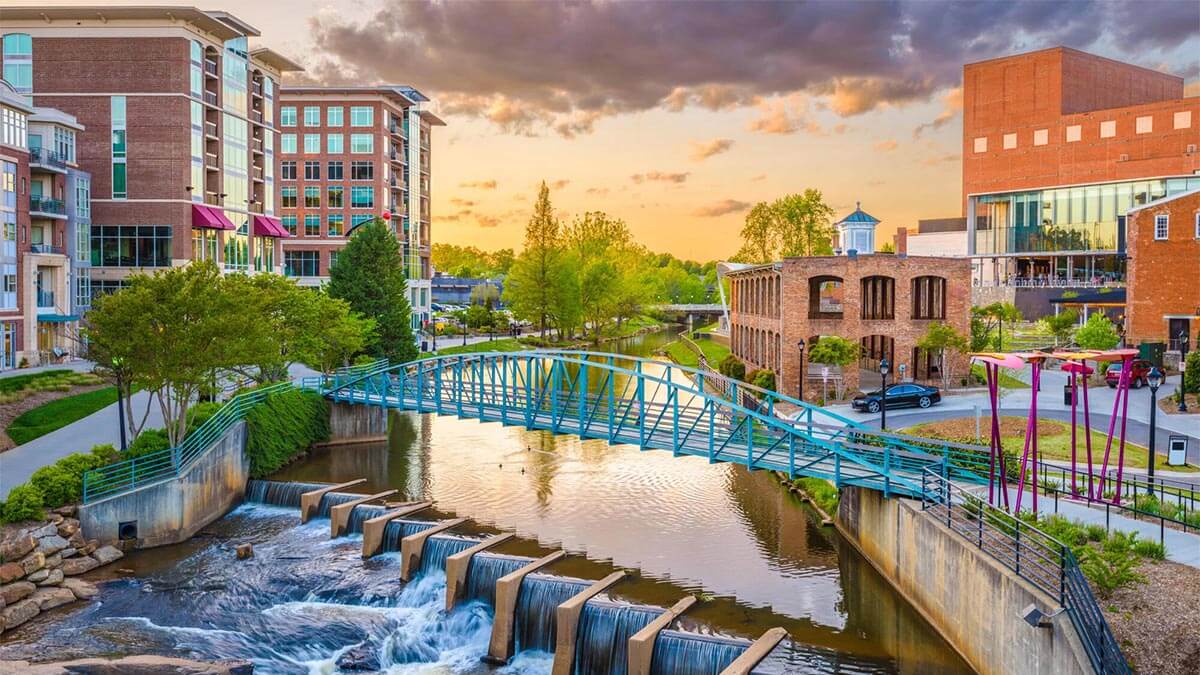
Greenville, SC is widely considered an excellent place to live, combining a cost of living roughly 9-10% below the national average with a thriving walkable downtown, a strong job market in advanced manufacturing and healthcare, and direct access to the Blue Ridge Mountains. The Greenville metro added 85,894 residents between the 2020 Census and July 2025, reaching a population of 1,014,101 at a 9.3% growth rate, placing it among the fastest-growing metros in the Southeast.
The table below shows where Greenville stands on the metrics that matter most to relocating households heading into 2026:
| Metric | Greenville, SC |
|---|---|
| Metro Population (July 2025 estimate) | 1,014,101 |
| Cost of Living vs. National Average | ~9-10% below |
| Average Home Value (April 2026) | $329,286 |
| Median Sale Price (March 2026) | $358,967 |
| Average Days to Contract | ~21 days |
| U.S. News Best Places to Live | Top-ranked SC metro |
Sources: Zillow (April 2026), U.S. Census Bureau (July 2025 estimate). Verify current figures before transacting.
This guide covers the pros and cons of living in Greenville, local housing costs and taxes, the job market, the best neighborhoods, schools, things to do, how Greenville compares to North Carolina, and the real story behind the city’s population trends.
Table of contents
- Pros of living in Greenville, SC
- Cons of living in Greenville, SC
- Cost of living in Greenville, SC in 2026
- Jobs and economy in Greenville, SC
- Best neighborhoods in Greenville, SC
- Schools and education in Greenville
- Things to do in Greenville, SC
- Is it better to live in NC or SC?
- Why are people moving out of Greenville?
- Frequently Asked Questions
Instant Valuation, Confidential Deals with a Certified iBuyer.com Specialist.
Sell Smart, Sell Fast, Get Sold. No Obligations.
Pros of living in Greenville, SC
According to the U.S. News Best Places to Live ranking for Greenville, the metro consistently places among the top destinations in the Southeast for quality of life. Below are the seven advantages residents cite most often.
Cost of living below the national average
Housing in Greenville runs 25-27% below the national average, and overall cost of living sits roughly 9-10% below comparable national benchmarks. Average rent for a one-bedroom apartment comes in below the national median, making Greenville an attractive landing spot for buyers and renters relocating from higher-cost coastal markets or larger metros like Atlanta and Charlotte.
Vibrant, walkable downtown Greenville
Downtown Greenville is highly walkable, with a WalkScore in the upper 70s, more than 100 restaurants, a growing craft brewery scene, and boutique retail lining Main Street. Falls Park on the Reedy (a 26-acre park with a suspension bridge over a natural waterfall) anchors the corridor and draws visitors year-round. The district routinely appears on national best-downtown lists and continues to attract new private investment.
Strong job market and major employers
Greenville is home to Michelin North America’s headquarters and sits roughly 25 miles from BMW Manufacturing in Greer, one of the largest vehicle-exporting plants in the United States. GE Power and Prisma Health (the largest private employer in South Carolina) round out the anchor employer base, alongside a growing life sciences and technology sector. This diversity gives the metro unusual economic resilience compared to single-industry towns.
Outdoor recreation near the Blue Ridge
The Swamp Rabbit Trail stretches nearly 22 miles, connecting downtown Greenville to Travelers Rest along a paved multi-use corridor that serves as both a recreational asset and a practical commuting route for cyclists. Table Rock, Caesars Head, and Jones Gap state parks are all within an hour’s drive, offering hiking, climbing, and backcountry camping. Asheville, NC is roughly an hour away; Charlotte is about an hour and 15 minutes; Atlanta is approximately two hours south.
Top-rated schools and education options
Greenville County Schools serves more than 77,000 students, making it the largest district in South Carolina, with several schools earning A and B grades on Niche. Furman University (a nationally ranked liberal arts college) sits within the city limits. Clemson University is roughly 30 miles west and the University of South Carolina is about 90 miles east, both accessible for working professionals and families with college-bound students.
Great year-round weather
Greenville’s climate features four distinct seasons with mild winters. Average January lows hover around 32°F, and spring arrives by early March. The Upstate’s elevation keeps summer temperatures a few degrees cooler than coastal South Carolina, though July highs still average around 90°F. Snow is uncommon, typically limited to one or two light events per year.
Central location between Atlanta and Charlotte
Greenville’s position along the I-85 corridor makes it practical for travelers and remote workers who need occasional access to major metros. The Greenville-Spartanburg International Airport (GSP) serves several direct routes to the Northeast and Midwest, reducing the need to connect through Charlotte Douglas or Hartsfield-Jackson for most trips.
Cons of living in Greenville, SC
Greenville’s rapid growth brings real trade-offs. These are the five drawbacks that current residents and recent arrivals mention most consistently.
Traffic congestion on I-85 and Woodruff Road
Rush-hour congestion on I-85 and the Woodruff Road commercial corridor has become one of the most-cited frustrations in the metro. The regional road network was not built for a population of one million, and infrastructure expansion has not kept pace with development. Peak commutes from suburban areas like Simpsonville or Mauldin into downtown can stretch 30 to 45 minutes on busy days.
Rising housing costs and rents
The average Greenville home value reached $329,286 in April 2026, up 2.4% year-over-year according to Zillow. Homes that listed around $250,000 in 2018 now regularly exceed $350,000 for comparable square footage. The MIT-calculated living wage for a single adult with no children in the Greenville metro is approximately $23.11 per hour, a figure that reflects how rising housing and food costs have shifted the affordability equation for lower-income households.
Limited public transportation options
The Greenville Area Regional Transit (GREAT) system provides basic bus service on a limited number of routes with infrequent schedules outside peak hours. For most residents living beyond a few walkable downtown blocks, a personal vehicle is a practical necessity. Public transit gaps are an ongoing topic in local planning discussions, but no major system expansion is currently funded.
Hot, humid summers and high pollen
Summers are warm and humid, with average July highs around 90°F and dew points that make midday outdoor activity uncomfortable during peak months. Spring brings one of the highest pollen counts in the country, driven by the surrounding tree canopy and agricultural land. Residents with allergies or respiratory conditions frequently cite this as a meaningful quality-of-life factor.
Car-dependent outside downtown
Beyond the walkable core and the Swamp Rabbit Trail corridor, the wider metro is car-dependent by design. Suburbs like Greer, Mauldin, and Taylors were developed around surface parking and strip-mall commercial patterns rather than pedestrian infrastructure. Residents who want to live car-free are effectively limited to a few blocks of downtown.
Cost of living in Greenville, SC in 2026
Greenville’s affordability is its most frequently cited advantage, and the numbers support the claim. The metro’s overall cost of living runs about 9-10% below the U.S. average, with housing as the primary driver.
Housing costs in Greenville
According to 2026 Greenville home values and market data from Zillow, the average home value reached $329,286 in April 2026 (up 2.4% year-over-year), the median sale price came in at $358,967 as of March 2026, and homes are going under contract in approximately 21 days on average. The median list price as of April 2026 was $389,267, suggesting sellers are pricing above recent sale comps in anticipation of continued demand.
Housing costs run 25-27% below the national average, making Greenville attractive to buyers relocating from Charlotte, Atlanta, or coastal South Carolina. If you are buying or selling in the Greenville market, reviewing SC seller closing costs before you finalize a transaction is a practical next step.
| Category | Greenville, SC | U.S. Average | Edge |
|---|---|---|---|
| Housing | ~25-27% below avg | Baseline | Greenville lower |
| Groceries | ~1-3% above avg | Baseline | Roughly equal |
| Transportation | ~3-5% below avg | Baseline | Greenville lower |
| Utilities | ~5-8% below avg | Baseline | Greenville lower |
| Healthcare | ~3-5% below avg | Baseline | Greenville lower |
| Overall | ~9-10% below avg | Baseline | Greenville lower |
Based on AreaVibes livability index and MERIC 2025 state cost data. Verify current figures before transacting.
Taxes in South Carolina
South Carolina uses a progressive income tax structure with a top rate currently reaching 6.5%, which is higher on paper than some neighboring states. Property taxes, however, are among the lowest in the Southeast. Primary residences qualify for a 4% assessment ratio under the owner-occupied exemption, which significantly reduces the effective property tax burden for homeowners. For a detailed breakdown of what sellers owe at the closing table, see SC home sale taxes.
Everyday expenses and utilities
The Greenville cost of living index and livability score from AreaVibes shows transportation and utilities both running below the national average. Grocery prices are roughly in line with national norms or slightly above, depending on the specific category and store. The MIT living wage calculator estimates a single adult with no children needs approximately $23.11 per hour to cover basic expenses in the Greenville metro, a figure that has risen with housing and food costs over the past three years.
Jobs and economy in Greenville, SC
Greenville is widely described as the economic engine of South Carolina. The metro has attracted sustained foreign direct investment, built a diversified industrial base, and maintained unemployment that consistently runs near or below the national average.
Major employers in Greenville
The metro’s largest and best-known employers include:
- Michelin North America (headquarters in Greenville)
- BMW Manufacturing (Greer, SC, approximately 25 miles from Greenville, with more than 11,000 employees and over $14 billion in total investment)
- GE Power (Greenville)
- Prisma Health (largest private employer in South Carolina)
- Regional headquarters and distribution operations for several additional companies anchored along the I-85 corridor
Advanced manufacturing, healthcare, life sciences, and technology are the four fastest-growing employment sectors. The presence of Michelin and BMW has pulled a deep supply-chain ecosystem into the Upstate, creating thousands of secondary manufacturing and logistics jobs throughout the region.
Unemployment rate and job growth
The Bureau of Labor Statistics Greenville metro employment data for the Greenville-Anderson-Mauldin MSA tracks monthly employment and sector-level changes. The metro’s job growth rate has outpaced the national average consistently over the past five years, with healthcare and advanced manufacturing leading gains. Check BLS at publication time to insert the current unemployment rate for the MSA.
Healthcare and advanced manufacturing
Prisma Health operates a major system across the Upstate and is one of the top employers for nurses, physicians, and allied health professionals in the region. On the manufacturing side, the BMW and Michelin plants consistently rank among the most productive facilities in their respective global networks. South Carolina’s targeted incentive programs for foreign direct investment have continued to attract new entrants, with several German and Japanese auto-supply companies opening Upstate facilities in recent years.
Best neighborhoods in Greenville, SC
Greenville’s neighborhoods range from historic in-town corridors with walkable access to a growing ring of family-friendly suburbs with active new-construction pipelines. The City of Greenville official neighborhood information provides boundary maps and planning data for the major residential areas below.
Downtown Greenville
Downtown is the most walkable part of the city, with a WalkScore in the upper 70s and direct access to Falls Park, Main Street dining, and the Peace Center for the Performing Arts. Housing options include condos, townhomes, and converted loft apartments. Prices are the highest in the metro for comparable square footage, but the trade-off is proximity to what drives Greenville’s national reputation.
Augusta Road corridor
The Augusta Road area is an established, tree-lined neighborhood popular with families and professionals. Home prices sit above the metro median. Proximity to well-regarded Greenville County schools and an independent retail corridor along Augusta Road itself are the primary draws for buyers competing in this submarket.
North Main Street area
North Main runs from downtown toward Furman University and includes a stretch of historic bungalows and mid-century homes at price points typically below the Augusta Road corridor. The neighborhood has a strong local identity, an active neighborhood association, and easy bike access to downtown via the Swamp Rabbit Trail connector.
Travelers Rest and Simpsonville
Travelers Rest sits at the northern terminus of the Swamp Rabbit Trail, giving residents trail access without downtown density. Home prices are generally lower than in-town options, and the town has developed its own restaurant and retail scene. Simpsonville, in the southwestern suburbs, is the most active submarket for new construction and is popular with families seeking larger homes at competitive price points.
Schools and education in Greenville
Greenville County Schools (public)
Greenville County Schools is the largest district in South Carolina, serving more than 77,000 students across elementary, middle, and high schools throughout the county. Niche grades for Greenville schools and neighborhoods rate the district B+ overall, with several schools earning A grades for academics and student outcomes. Mauldin High, J.L. Mann High, and Greenville High are frequently cited as the district’s strongest comprehensive campuses.
Private and charter school options
Notable private schools in the area include Christ Church Episcopal School (pre-K through 12th grade, well-regarded for college placement), Southside Christian School, and Wade Hampton Academy. The county also operates several magnet and STEM-focused programs within the public system. Charter options have expanded over the past decade, giving families more flexibility within the county’s geographic footprint.
Colleges and universities nearby
Furman University, located within the Greenville city limits, consistently ranks among the top liberal arts colleges in the South. Clemson University’s main campus is roughly 30 miles west, and the University of South Carolina is about 90 miles east in Columbia. Greenville Technical College serves tens of thousands of students annually with associate degree programs, workforce training, and a transfer pipeline into four-year institutions.
Things to do in Greenville, SC
Swamp Rabbit Trail and outdoor parks
The Swamp Rabbit Trail runs nearly 22 miles from downtown Greenville to Travelers Rest, making it one of the longest paved multi-use trails in the Southeast. The trail connects neighborhoods, parks, breweries, and restaurants, functioning as both a recreational corridor and a practical commuting route for cyclists. Table Rock, Caesars Head, and Jones Gap state parks are all within an hour’s drive and offer hiking, fishing, and backcountry camping.
Falls Park and downtown dining
Falls Park on the Reedy is the centerpiece of downtown’s public space network, featuring a suspension bridge over a series of waterfalls, formal gardens, and lawn space that hosts festivals year-round. Downtown Greenville has more than 100 restaurants, ranging from chef-driven spots to casual craft breweries. The culinary scene has grown substantially since 2015 and regularly draws coverage from national food publications.
Arts, culture, and events
The Peace Center for the Performing Arts hosts Broadway touring productions, symphony performances, and major concerts in a renovated riverfront complex. Annual events include Fall for Greenville (one of the largest food festivals in the Southeast), Artisphere (a juried fine arts festival on Main Street), and Euphoria (a food and music festival each September). The Greenville County Museum of Art holds one of the most significant collections of Andrew Wyeth paintings outside of the Brandywine River Museum.
Sports in Greenville
The Greenville Drive is the High-A affiliate of the Boston Red Sox and plays at Fluor Field, a downtown ballpark modeled closely after Fenway Park. The minor league season runs from April through September and offers family-friendly entertainment steps from Main Street. The Carolina Panthers and Charlotte FC are roughly 90 minutes north, and Clemson University football draws strong regional attendance to games 30 miles west in Clemson.
Is it better to live in NC or SC?
On total monthly cost, South Carolina is roughly 8.7% cheaper than North Carolina, a gap that adds up to thousands of dollars per year for most households. The MERIC 2025 cost-of-living index ranks South Carolina 20th lowest nationally and North Carolina 27th lowest, giving SC a meaningful affordability edge.
Cost of living: NC vs. SC
A comparable monthly budget in North Carolina runs approximately $3,701 versus $3,380 in South Carolina, based on 2025 state cost comparisons. That $321 monthly difference reflects lower housing, utility, and transportation costs in South Carolina rather than any single dominant factor.
Housing costs: NC vs. SC
Housing drives most of the gap between the two states. Greenville home prices average $329,286 (April 2026, Zillow), while comparable markets in North Carolina, particularly the Charlotte suburbs, tend to run higher for similar square footage. Charlotte itself carries a significantly higher cost base for buyers. For a specific breakdown of what home purchase transactions cost in South Carolina, see SC closing costs before committing to an offer.
Tax rates: NC vs. SC
North Carolina uses a flat income tax rate of 4.25% (with a phased reduction to 3.99% scheduled), while South Carolina’s progressive system reaches up to 6.5% at the top bracket. South Carolina wins clearly on property taxes, with rates well below North Carolina’s averages and a 4% owner-occupied assessment ratio that materially lowers the effective property tax burden for homeowners. The net comparison is close for most middle-income households; higher earners may lean toward NC’s flat structure.
Job market: NC vs. SC
North Carolina’s job market is larger in absolute terms, anchored by the Research Triangle and Charlotte’s financial sector. Average salaries in North Carolina run modestly higher than South Carolina’s in technology and finance. Greenville specifically punches above its weight given the Michelin, BMW, and GE employer base. For workers in advanced manufacturing or healthcare, the wage gap between the two states narrows considerably.
| Category | South Carolina | North Carolina | Edge |
|---|---|---|---|
| Cost of Living Index (MERIC 2025) | 20th lowest nationally | 27th lowest nationally | SC |
| Estimated Monthly Budget | ~$3,380 | ~$3,701 | SC |
| Top Income Tax Rate | Progressive, up to 6.5% | Flat 4.25% | NC |
| Property Taxes | Lower (4% owner-occupied ratio) | Moderate | SC |
| Grocery Costs | Slightly higher | Lower | NC |
| Job Market Size | Smaller, growing fast | Larger | NC |
| Average Home Prices | Lower overall | Higher (especially Charlotte area) | SC |
Based on MERIC 2025 state cost data and Bureau of Labor Statistics state employment figures. Verify current rates before financial decisions.
Why are people moving out of Greenville?
Greenville is overwhelmingly a net migration destination, not a city people are fleeing. The Greenville-Anderson-Mauldin metro added 85,894 residents between the 2020 Census and July 2025, reaching a population of 1,014,101 at a 9.3% growth rate, according to reporting from the Post and Courier on Greenville population growth. For every 100 people considering leaving South Carolina, roughly 218 are actively looking to move in, a ratio that speaks to the state’s continued attractiveness as a relocation destination.
That said, some residents do choose to leave, and their reasons are consistent. Rising home prices are the most common driver: a home that listed around $250,000 in 2018 can now exceed $350,000 for comparable square footage. Traffic congestion on I-85 and Woodruff Road is a second frequent complaint, particularly among long-time residents who remember the city’s smaller footprint before a decade of rapid development. A third group cites a loss of the “small-town character” that defined Greenville before large-scale commercial growth took hold.
Weather plays a role for some as well. The combination of hot humid summers and one of the highest spring pollen counts in the country leads a portion of residents to prefer drier climates in the Southwest or higher elevations elsewhere.
The important context is that outmigration data for Greenville is largely anecdotal, drawn from local real estate commentary rather than verified Census migration streams. The population numbers tell the clearest story: this metro is growing, and the direction of that growth shows no signs of reversing.
Planning a move to Greenville often means selling a home first. iBuyer.com connects sellers with multiple competing cash offers and a closing window of 7 to 30 days, removing the timing uncertainty that makes relocation unpredictable. If you are already in the Greenville market, Greenville cash buyers is a practical starting point for understanding what a direct cash sale looks like locally. For broader statewide context, the South Carolina living overview covers the factors that shape Greenville’s growth and affordability at the state level.
Compare Cash Offers from Top Home Buyers. Delivered by Your Local iBuyer Certified Specialist.
One Expert, Multiple Offers, No Obligation.
Know Your Local Market Before You List
Pull the last 12 months of real sales and buyer activity for your neighborhood.
Get My Market ReportFrequently Asked Questions
Greenville, SC is widely considered an excellent place to live, with costs 9-10% below the national average and a strong job market in advanced manufacturing and healthcare. The metro has added nearly 86,000 residents since 2020, signaling sustained demand from relocating households.
The main pros include affordable housing, a walkable downtown, strong jobs in manufacturing and healthcare, and Blue Ridge Mountain access within an hour. The main cons are traffic congestion on I-85, rising home prices, limited public transit, and hot humid summers with high spring pollen counts.
Greenville’s overall cost of living runs roughly 9-10% below the national average, with housing costs 25-27% below. The MIT living wage for a single adult with no children is approximately $23.11 per hour in the metro.
The average Greenville home value was $329,286 in April 2026, up 2.4% year-over-year, with a median sale price of $358,967 as of March 2026, according to Zillow. Homes are going under contract in approximately 21 days on average.
Greenville is a net migration destination, gaining 85,894 residents from 2020 to July 2025. Those who do leave most often cite rising home prices, traffic congestion on I-85, or a preference for the smaller-town feel that predevelopment Greenville offered.
South Carolina is roughly 8.7% cheaper than North Carolina on a monthly cost basis, with lower housing costs and property taxes. North Carolina offers a lower flat income tax rate of 4.25% and slightly higher average salaries in technology and finance.
According to U.S. Census Bureau data, the Greenville city population is approximately 60-65% white non-Hispanic, with significant Black, Hispanic, and Asian communities present. The broader metro’s demographic mix varies considerably by suburb and township.
The most popular in-town neighborhoods are Downtown, Augusta Road, and North Main. Travelers Rest and Simpsonville are the leading suburban choices, offering trail access and new construction at lower price points than in-town alternatives.
Major employers include Michelin North America (headquartered in Greenville), BMW Manufacturing in Greer with more than 11,000 employees, GE Power, and Prisma Health, the largest private employer in South Carolina.
Greenville County Schools is the largest district in South Carolina, serving more than 77,000 students and rated B+ overall on Niche. The area also includes Furman University within city limits and is within 30 miles of Clemson University.
Traffic in Greenville has worsened significantly as the metro topped one million residents, with I-85 and Woodruff Road seeing heavy congestion during rush hours. Suburban commutes into downtown can run 30 to 45 minutes on busy days.
Greenville has mild winters and four distinct seasons, with warm humid summers averaging around 90°F in July and one of the highest spring pollen counts in the country. The Upstate’s elevation keeps temperatures a few degrees cooler than coastal South Carolina.
Crime rates in Greenville vary by neighborhood, with downtown and most suburban areas considered safe while some inner-city corridors report above-average property crime rates. Reviewing neighborhood-specific data on Niche or NeighborhoodScout before choosing a specific area is advisable.

Reilly Dzurick is a licensed real estate agent with over six years of experience and a member of the iBuyer.com Market Insights Team, covering national trends in home selling and the evolving iBuyer landscape. Her firsthand experience working with buyers and sellers gives her a practical perspective on how these platforms impact real homeowners. She holds a degree in Public Relations, Advertising, and Applied Communication.