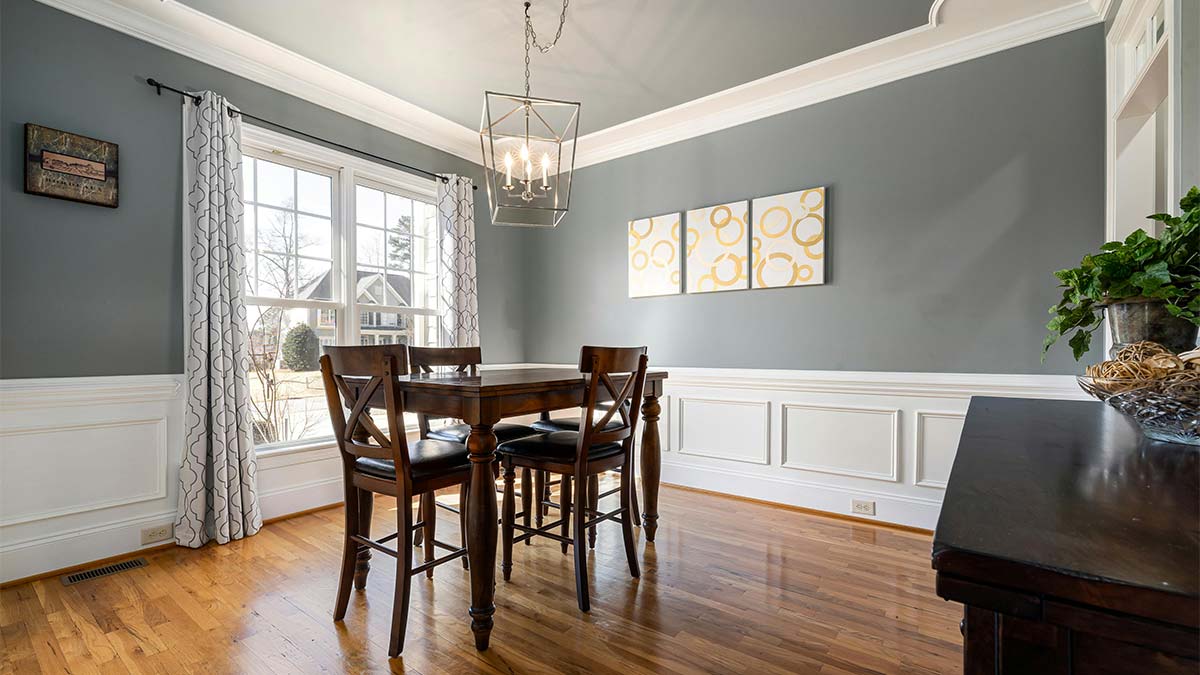
Wainscoting rarely increases a home’s appraised value dollar-for-dollar, but it adds real salability and perceived value that can accelerate your sale. Appraisers treat wall paneling as a cosmetic finish, not a structural improvement, so you won’t find a wainscoting line item in a formal home appraisal. Buyers notice it, though, and homes with well-executed wainscoting in dining rooms and entryways attract more interest and competing offers.
The key variables are which rooms you install it in, how well it’s executed, and how much you spend relative to your listing timeline. Wainscoting cost ranges from $10 to $40 per square foot installed, and a standard dining room project runs $750 to $3,600 depending on style and material. The return shows up in buyer appeal and salability, not in the appraisal number.
This guide covers what wainscoting is and the main types of wainscoting available, whether it increases appraised or perceived value, the golden rule for wainscoting height and proportions, 2026 costs by material, a room-by-room impact breakdown, current interior design trends 2026, and when to skip it entirely before you list.
Wainscoting Value
- What is wainscoting?
- Does wainscoting increase your home’s appraised value?
- What is the golden rule for wainscoting height?
- How much does wainscoting cost in 2026?
- Where wainscoting adds the most value, room by room
- Is wainscoting outdated or still in style in 2026?
- Does wainscoting make a room look larger or smaller?
- When wainscoting won’t add value to your home
- Is wainscoting worth it before you sell?
- See what buyers will pay before you renovate
- Frequently Asked Questions
Skip the Renovation, See Cash Offers Get competing offers on your home before spending $1,500 on wainscoting
No repairs, no commissions, no obligation.
What is wainscoting?
Wainscoting is decorative paneling applied to the lower portion of interior walls, typically covering the bottom one-third of the wall height. It originated as a functional wall treatment protecting plaster from damage in high-traffic areas, and it remains one of the most recognized architectural details in American home design. Modern installations are almost entirely decorative, chosen for buyer appeal and the impression of craftsmanship they signal during showings.
Types of wainscoting
The four main types of wainscoting differ in profile, cost, and the buyer signal they send:
- Beadboard: Classic, grooved vertical planks. Affordable and widely used in bathrooms, hallways, and casual spaces. Installed cost: $10 to $15 per square foot.
- Raised panel: Traditional profiles with beveled frames and raised center fields. The most formal and most expensive type. Installed cost: $20 to $30 per square foot.
- Board and batten: Wide vertical boards with narrow battens over seams. Associated with modern farmhouse and transitional design. Installed cost: $12 to $20 per square foot.
- Flat panel: Clean, frameless panels with a flush surface. Contemporary and minimal. Installed cost: $10 to $18 per square foot.
Understanding the types of wainscoting matters for both design coherence and budgeting before a sale. Each type sends a different signal to buyers about the home’s design era and price tier.
Materials: wood, MDF, PVC, and vinyl
Solid wood carries the highest cost and the strongest buyer perception. MDF (medium-density fiberboard) is the most common budget material and performs well in dry interior spaces, but it swells in high humidity. PVC and vinyl wainscoting hold up better in bathrooms and powder rooms where moisture exposure is ongoing. For sellers, material quality is the primary differentiator between a wainscoting installation that elevates buyer perception and one that reads as a cost-cutting decision.
Does wainscoting increase your home’s appraised value?
Wainscoting rarely increases a home’s appraised value dollar-for-dollar. It can add real perceived value that speeds up your sale, and in competitive markets, that buyer appeal often matters more than any shift in the formal appraisal number. The question of does wainscoting increase home value depends entirely on which type of value you mean.
One seller whose home entered iBuyer.com’s buyer network had recently added raised-panel wainscoting to the entry foyer and dining room before listing. The home received three competing offers within the first week on market. Multiple buyers commented on the entry during showings. The appraised value did not change, but the sale price reflected the buyer competition the architectural detail generated. That gap between appraised value and final sale price is where wainscoting home value actually lives.
What appraisers actually count
Appraisers focus on quantifiable improvements: square footage, bedroom and bathroom count, lot size, condition rating, and comparable sales. Wainscoting is treated as cosmetic decor, not a structural or functional upgrade. Per the Appraisal Institute’s guidance on how appraisers value cosmetic upgrades, decorative finishes do not receive independent dollar-for-dollar line items in residential valuations.
No appraiser will add $5,000 to $10,000 to a home appraisal specifically for wall paneling. Wainscoting can indirectly improve a condition rating if it covers damaged walls, but that benefit is incidental rather than guaranteed.
Perceived value vs. appraised value
Wainscoting home value falls into two distinct categories. Appraised value is the formal dollar figure a licensed appraiser assigns based on condition and comparable sales. Perceived value is the impression a buyer forms during a showing, which influences how much they offer and whether they compete with other buyers.
Well-executed wainscoting improves perceived value, and that perception can close the gap between a list price and a final sale price. Buyers associate raised panel and board and batten styles with craftsmanship, quality materials, and intentional design. In entry and dining spaces especially, those signals translate directly into buyer confidence and offer motivation.
Does wainscoting increase home value on an appraiser’s report? Rarely. Does it improve salability? Consistently, when installation quality and style coherence are both present.
What is the golden rule for wainscoting height?
The golden rule for wainscoting is the rule of thirds: divide your ceiling height by three to get the optimal wainscoting height from the floor, including baseboard and cap rail. This principle has guided classical architectural proportion for centuries and remains the standard reference point for wainscoting height in residential design.
On an 8-foot ceiling, one-third equals 32 inches. On a 9-foot ceiling, the standard is 36 inches. On a 10-foot ceiling, 40 inches is the baseline, with an option to extend to 48 inches in formal dining rooms. Never split the wall at the midpoint. A 50/50 division reads as visually unbalanced in every ceiling height and every room type.
The rule of thirds explained
The rule of thirds works because the human eye naturally divides a wall into foreground and background. When the lower section is one-third of the total height, the eye reads the wall as proportionally balanced. The wainscoting anchors the base, and the open wall above provides visual breathing room.
A 50/50 split creates tension. Neither section reads as dominant, and the chair rail sits at eye level where it competes with the viewer’s sightline rather than framing it. Strict use of the rule of thirds eliminates this problem and keeps the decorative zone below eye level in most standard rooms.
Standard heights by ceiling height
Professional height standards for wainscoting from This Old House align with the following benchmarks:
| Ceiling Height | Recommended Wainscoting Height | Style Note |
|---|---|---|
| 8 ft (96″) | ~32″ | Standard chair-rail height; works in most rooms |
| 9 ft (108″) | ~36″ | Most common U.S. new-construction ceiling height |
| 10 ft (120″) | ~40″ | Can extend to 48″ in formal dining rooms |
| 10+ ft | 40 to 48″ | Two-thirds height appropriate for dramatic spaces |
Based on standard architectural proportion guidelines and installer best practices, 2026. Verify with your installer before purchasing materials.
These wainscoting height benchmarks apply across all the main types of wainscoting, regardless of style or material choice.
Adjusting the rule for your room
Rooms with ceilings at 10 feet or higher sometimes warrant extending paneling to two-thirds of the wall height for a more formal, dramatic effect. This works well in dining rooms and libraries but can feel oppressive in smaller bedrooms or narrow hallways.
Chair rail height, typically 32 to 36 inches, marks the transition point in most installations. Including baseboard height (typically 3 to 5 inches) in your total measurement prevents a common proportion error where panels stop too low because the baseboard was not factored into the calculation.
How much does wainscoting cost in 2026?
Wainscoting cost ranges from $10 to $40 per square foot installed, depending on material and style. That range spans a beadboard MDF project in a powder room at the low end and custom solid-wood raised panel in a formal dining room at the high end.
Cost by material and style
| Style | Installed Cost per Sqft | DIY Materials Only |
|---|---|---|
| Beadboard | $10 to $15 | $2 to $5 |
| Flat panel | $10 to $18 | $2 to $6 |
| Board and batten | $12 to $20 | $3 to $7 |
| Raised panel | $20 to $30 | $5 to $10 |
| Custom millwork | $35 to $40+ | N/A (custom fabrication) |
Based on national installation cost averages from Angi, 2026. Verify current rates with local installers before purchasing materials.
Material costs have shifted with lumber and MDF pricing in recent years. PVC wainscoting, priced comparably to MDF, is increasingly used in bathrooms as a moisture-resistant alternative.
DIY vs. professional installation
DIY wainscoting using MDF kits costs $2 to $7 per square foot in materials only, but requires precise cuts to avoid visible seams after painting. Any gap wider than a credit card thickness remains visible post-paint and reduces buyer appeal noticeably during showings.
Professional labor adds $3 to $10 per square foot in most U.S. markets. For sellers preparing to list, the difference between professional and DIY execution is often the difference between a positive buyer response and a neutral one. DIY installation is more practical for long-term owner-occupants than for sellers with a listing date on the calendar.
Total project cost for a standard room
A standard 10×10 dining room with 8-foot ceilings and wainscoting on three walls covers roughly 75 to 90 square feet of lower-wall area. At installed rates by style:
- Beadboard: $750 to $1,350
- Board and batten: $900 to $1,800
- Raised panel: $1,500 to $2,700
- Custom millwork: $2,625 to $3,600+
For sellers weighing wainscoting cost against their listing timeline, the total-room figure matters more than the per-sqft number in isolation.
Where wainscoting adds the most value, room by room
Not every room benefits equally from wainscoting. Buyer impact depends on how buyers use the space and what quality associations they bring to it. Buyer preferences for architectural detail from NAR research confirm that first-impression spaces carry disproportionate weight in offer decisions.
| Room | Buyer Impact | Recommended Style |
|---|---|---|
| Dining room | High; formal buyers expect architectural detail | Raised panel or board and batten |
| Entryway/foyer | High; first impression is a disproportionate signal | Raised panel or beadboard |
| Staircase/hallway | Medium-high; adds architectural depth throughout | Board and batten |
| Powder room | Medium; striking in small spaces with low material cost | Beadboard or flat panel |
| Living room | Medium; works in traditional or transitional homes | Board and batten or flat panel |
| Primary bedroom | Low-medium; personal taste polarizes buyers | Flat panel or beadboard only |
| Kitchen | Low; can feel dated; avoid unless historically appropriate | Beadboard only, used sparingly |
Based on buyer preference patterns and iBuyer.com seller transaction observations, 2026.
Dining rooms and entryways: highest buyer impact
Buyers form their first impression in the foyer before they see any other room. Raised panel and board and batten wainscoting in entry spaces signal craftsmanship from the first step inside. Dining rooms with architectural detail consistently attract buyer comments about perceived quality, which feeds directly into offer motivation.
One seller whose home was evaluated through iBuyer.com’s buyer network had added wainscoting to both the entry foyer and dining room before receiving offers. Multiple buyers cited the entry-to-dining continuity as a quality signal that distinguished the home from comparable listings in the same ZIP code. The total wainscoting cost was approximately $2,200. The home received four offers in the first 10 days on market.
Staircases and hallways
Board and batten works well in staircases and hallways because the vertical lines complement the horizontal movement of the stair. Wainscoting height in these spaces follows the same rule of thirds principle, measured perpendicular to the slope of the stair rather than from a fixed floor level.
Bathrooms and powder rooms
Powder rooms deliver strong buyer impact relative to their small square footage and low material cost. A beadboard or flat panel installation in a powder room can transform an otherwise forgettable space into a design highlight. PVC is the practical material choice here: MDF swells in high-humidity conditions, and a visibly warped panel is a buyer red flag in any showing or inspection.
Rooms where wainscoting underperforms
Kitchens consistently show the weakest buyer response to wainscoting. Most buyers and designers associate kitchen paneling with 1980s and early 1990s design, and it can make a kitchen feel dated even in an otherwise updated home. Primary bedrooms also underperform: buyer preference in private spaces is strongly personal, and wainscoting there risks polarizing rather than consistently attracting interest.
Is wainscoting outdated or still in style in 2026?
Wainscoting is not outdated. It is experiencing a clear revival, with interior design trends 2026 moving away from uniform white panels toward bolder colors and more varied color-pairing approaches. Deep greens, navies, and warm terracottas have replaced classic white as the dominant wainscoting color choices in high-end design publications and designer showcases this year.
The long-standing question of whether wainscoting is dated no longer has a simple yes or no answer. The form has not dated; the color convention has shifted.
Classic vs. contemporary wainscoting
Traditional raised-panel wainscoting in heritage-style, Colonial, and Victorian homes remains entirely appropriate and strongly buyer-positive. That context calls for white or off-white panels, classical proportions, and formal rooms where the style fits the architecture.
Contemporary applications favor flat panels and board and batten in muted or bold tones. Clean lines and minimal profiles replace ornate Victorian profiles in modern and transitional homes. The types of wainscoting that work best in 2026 design contexts depend on what the rest of the home communicates architecturally.
2026 color trends for wainscoting panels
Per 2026 wall treatment design trends from Architectural Digest, the dominant shift in wainscoting design is the “drenched in color” approach. Panels and the wall above are painted in closely related or matching tones for a cohesive, immersive look rather than a high-contrast white-on-color division. Deep greens, soft navies, and warm terracotta tones are the most cited color directions this year.
For sellers listing in 2026, classic white or warm greige in a neutral finish remains the safest color choice for maximum buyer appeal across the widest buyer pool. The bold color revival is a design statement, not a universal salability tool. If you’re installing wainscoting within 12 months of listing, stick to tones that appeal to buyers with varied color preferences.
Does wainscoting make a room look larger or smaller?
Wainscoting can make a room look larger or smaller depending on three factors: panel height, color contrast, and ceiling height. The outcome is not fixed by the presence of wainscoting itself, but by how it’s proportioned relative to the room’s dimensions.
When wainscoting opens up a space
Low wainscoting at chair rail height (32 to 36 inches) in a light color with lighter paint above draws the eye horizontally and can help small rooms feel more open. The rule of thirds ratio keeps the decorative zone at the base, allowing the upper two-thirds of the wall to read as expansive. Color-matching panels to a similar tone as the upper wall softens the dividing line and reduces visual compartmentalization.
According to designer guidance on wainscoting proportions from Houzz, wainscoting can also help scale down a very large room by visually drawing the perimeter in, and it can lower the perceived ceiling height in rooms where the ceiling feels too high relative to the room’s width.
When wainscoting makes a room feel smaller
Tall, dark wainscoting in a room with an 8-foot ceiling makes the space feel more closed in by shortening the visible wall line. High-contrast combinations (dark panels against a light upper wall) emphasize the horizontal division and make the room feel cut in half vertically.
A 50/50 wall split is the most common proportional mistake and creates visual imbalance in any room size. Following the rule of thirds prevents this outcome and preserves the spatial openness that makes well-proportioned wainscoting a positive buyer signal rather than a liability.
When wainscoting won’t add value to your home
Wainscoting becomes a liability rather than an asset when five specific conditions apply. Poor execution lowers buyer perception below what a home with no wainscoting at all would achieve. Understanding these failure modes is as important for sellers as knowing where wainscoting helps.
According to common installation mistakes that reduce appeal from Bob Vila, here are the five conditions where wainscoting subtracts value rather than adding it:
- Poor installation quality. Visible gaps, misaligned panels, or warped MDF lower buyer perception noticeably. Buyers spot imprecise seams even under a fresh coat of paint.
- Style mismatch. Ornate Victorian raised panels in a mid-century modern home, or beadboard in a contemporary minimalist space, signals a renovation done without design awareness. Coherence between wainscoting style and home architecture is non-negotiable for positive buyer response.
- Over-application. Wainscoting in every room including kitchens, laundry rooms, and utility spaces reads as a patch job rather than a considered architectural design decision. The accent value disappears when it becomes the default wall treatment throughout the home.
- Trendy micro-trend colors. Painting panels in a saturated, narrow-trend color reduces resale flexibility within 3 to 5 years as the trend passes. Neutral or muted tones carry a longer shelf life for sellers.
- Cheap materials that warp or crack. MDF in high-humidity bathrooms swells visibly over time. PVC performs better in those conditions, and a swelling panel is a buyer red flag in any inspection or showing.
For sellers whose home is already on the market and not moving, wainscoting won’t fix a pricing problem. Understanding when a price cut outperforms cosmetic upgrades is the more immediate decision for a stalled listing than any renovation project.
Installation quality issues
Professional installation produces tight, consistent seams and proper alignment at inside corners and stair bases, where material movement is most likely to expose gaps. Request a pre-paint walkthrough and inspect for any gap wider than a credit card before the painter arrives.
Style mismatches and over-application
Every type of wainscoting has an appropriate architectural context. Matching the wainscoting style to the home’s existing door profiles, window casings, and ceiling details is what separates a cohesive upgrade from a renovation that reads as out of place. A home improvement ROI calculation that doesn’t account for style coherence will overestimate the return.
Is wainscoting worth it before you sell?
Whether wainscoting is worth the investment before selling depends on three variables: your listing timeline, the rooms you’re targeting, and how market conditions shape buyer demand in your area. Wainscoting home value returns are not uniform across markets or market cycles, and the math changes significantly based on how soon you plan to list.
ROI by timeline and room type
Selling in 6 to 12 months: Entry and dining room wainscoting at $800 to $2,500 total wainscoting cost can accelerate sale speed without changing the formal appraisal number. This is the timeline where the home improvement ROI case is strongest for wainscoting. Perceived value upgrades have time to become part of the home’s presentation rather than a last-minute addition buyers may recognize as recent work.
Selling in 90 days or fewer: The ROI timeline does not justify $3,000 to $4,000 in custom professional wainscoting. Perceived value gains from wainscoting are better captured through price positioning in short-timeline situations. A well-priced home without wainscoting will outperform an overpriced home that has it.
The perceived value case is strongest in buyer’s markets where inventory is wide and homes need differentiation signals to attract offers. In a tight seller’s market with low inventory, wainscoting is a nice-to-have rather than a necessary pre-sale investment.
How long you plan to stay before selling factors directly into this math. Timing your home sale strategically involves more than renovation timing alone, and your full listing-readiness picture is the necessary context before committing to any improvement project. Does wainscoting increase home value enough to justify the spend on your specific home, in your market, on your timeline? That question has a different answer at 6 months than at 6 weeks.
How to Maximize Wainscoting’s Impact Before Selling Your Home
-
Choose the Highest-Impact Rooms First
Install wainscoting in the entryway, foyer, or dining room before updating other spaces. These rooms often create the strongest first impression and can provide the greatest visual impact for the investment.
-
Use the Rule of Thirds for Height
Measure the ceiling height and install the cap rail at approximately one-third of the wall height. For example, a typical 8-foot ceiling works well with wainscoting around 32 inches high, while a 9-foot ceiling is often suited to a height of about 36 inches.
-
Choose Materials That Match Your Home’s Value
Select materials that fit your home’s price range. MDF beadboard or flat panels work well for entry-level homes, while board-and-batten or raised wood panels are better suited for higher-priced properties.
-
Ensure a High-Quality Installation
Hire an experienced installer and inspect all joints and seams before painting. Tight, clean joints create a more professional appearance and improve buyer perception during showings.
-
Finish With a Neutral Paint Color
Choose timeless colors such as white, warm greige, soft navy, or muted sage to appeal to the widest range of buyers. Avoid bold or highly personalized colors if you plan to sell your home in the near future.
When to skip wainscoting and sell as-is
If your home needs structural or mechanical repairs, those take precedence over cosmetic wainscoting at every price tier. Buyers and appraisers both discount homes with deferred maintenance, and no amount of architectural detail overcomes a failing HVAC system or a roof that needs replacement.
For sellers who want to understand what buyers will actually pay for their home before committing to any improvement budget, getting competing offers first is the most rational starting point. Cash buyers evaluate a home’s overall condition rather than the presence or absence of any single cosmetic upgrade, which means you get a real-world number before you pick up a hammer.
See what buyers will pay before you renovate
If you’re weighing wainscoting cost against your listing timeline, there’s a path that removes the renovation decision entirely. Through iBuyer.com, sellers receive competing cash offers from vetted buyers who assess the home as-is, with no renovation budget, no staging, and no cosmetic checklist before close. Submit your address and condition details once and receive multiple offers, typically reviewed within 24 to 48 hours, with closing available in 7 to 30 days. Compare what buyers will actually pay before committing to a single improvement project.
Skip the Renovation, See Cash Offers Get competing offers on your home before spending $1,500 on wainscoting
No repairs, no commissions, no obligation.
Frequently Asked Questions
Wainscoting rarely increases a home’s appraised value dollar-for-dollar, but it adds perceived value that can speed up your sale. Appraisers treat wainscoting as cosmetic rather than structural, and no appraiser adds $5,000 to $10,000 to a valuation for panels alone. The real return is buyer appeal: homes with well-executed wainscoting in dining rooms and entryways attract more interest and competing offers. Whether wainscoting does increase home value depends entirely on which type of value you’re measuring.
The golden rule for wainscoting is the rule of thirds: install it to cover the bottom one-third of the wall. On an 8-foot ceiling, one-third equals 32 inches from the floor, including baseboard and cap rail. On a 9-foot ceiling, the standard is 36 inches; on a 10-foot ceiling, 40 inches. Never split the wall at the midpoint, because a 50/50 division reads as visually unbalanced at any ceiling height.
Wainscoting is not outdated; it is experiencing a revival in 2026 with bolder colors like deep green and navy replacing traditional white panels. Contemporary applications favor cleaner lines and flat panels rather than ornate Victorian profiles. The “drenched in color” approach, painting panels and the wall above in closely related tones, is the primary 2026 design direction. Traditional raised-panel wainscoting remains appropriate in heritage-style and formal homes.
Wainscoting can make a room look larger or smaller depending on its height, color, and the proportion of wall it covers. Low wainscoting at chair rail height (32 to 36 inches) in a light color with lighter paint above draws the eye horizontally and can open up a small room. Tall, dark wainscoting in a room with an 8-foot ceiling makes the space feel more closed in. Matching panel and wall color in similar tones softens the dividing effect.
Adding wainscoting before selling is a good idea in dining rooms and entryways, where buyer impact is highest, at a total wainscoting cost of $800 to $2,500. For sellers listing within 90 days, the ROI timeline rarely justifies $3,000 to $4,000 in custom professional installation. For sellers with 6 to 12 months before listing, entry and dining room wainscoting consistently earns positive buyer response without requiring a premium appraisal.
Wainscoting costs $10 to $40 per square foot installed, depending on material and style. Beadboard runs $10 to $15 per sqft installed; raised panel runs $20 to $30 per sqft; custom millwork reaches $35 to $40-plus per sqft. DIY MDF kits cost $2 to $7 per sqft in materials alone but require precise cuts to avoid visible seams. For a standard 10×10 dining room, expect $750 to $3,600 total depending on material choice.
Dining rooms, entryways, and staircases benefit most from wainscoting because buyers associate these spaces with architectural quality. Powder rooms also deliver strong impact relative to their small material cost. Kitchens and laundry rooms show the weakest buyer response and can read as dated when paneled. Bedrooms are a personal-taste decision that polarizes buyers rather than consistently attracting them.
Wainscoting should cover approximately one-third of the wall height; on 8-foot ceilings, that is 32 inches from the floor. On 9-foot ceilings, the most common height in U.S. new construction, 36 inches is the standard. On 10-foot ceilings, 40 inches works for most rooms and can extend to 48 inches in formal dining rooms. Including the baseboard and cap rail in your measurement prevents proportional miscalculation.
Raised-panel and board-and-batten wainscoting in high-quality wood add the most value because they signal craftsmanship over commodity finishes. Beadboard is the most affordable type and still positively received in casual spaces like bathrooms and hallways. MDF and PVC versions cost less but can read as lower quality to discerning buyers. In competitive price ranges, material quality is the primary differentiator for buyer perception.
Home appraisers do not add a specific dollar amount for wainscoting; they treat it as cosmetic, not a structural improvement. Appraisers focus on quantifiable features such as square footage, bedroom count, condition rating, and comparable sales in the area. Wainscoting can indirectly improve a condition rating if it covers damaged walls, but that benefit is incidental. The value it creates shows up in buyer competition, not appraisal line items.
Wainscoting can hurt resale value when it is poorly installed, style-mismatched to the home, or applied in kitchens and informal rooms throughout the house. Visible gaps, warped MDF panels, and misaligned seams lower buyer perception below a home with no wainscoting at all. Ornate Victorian panels in a mid-century modern home signal a renovation done without design awareness. Over-application across all rooms eliminates the architectural accent effect that makes wainscoting valuable.
DIY wainscoting using MDF kits costs $2 to $7 per square foot in materials, but poor seams visibly reduce buyer appeal. Professional installation adds $3 to $10 per sqft in labor but produces clean, tight joints that read as intentional craftsmanship. For sellers preparing to list, the difference between professional and DIY execution is often the difference between a positive and neutral buyer response. DIY is more practical for long-term owner-occupants than for sellers preparing to list.
Wainscoting refers to lower-wall paneling only; full wall paneling covers the entire wall, making wainscoting the more targeted and less expensive option. Wainscoting typically covers 30 to 40 percent of the wall’s height, leaving the upper portion for paint or wallpaper. Full paneling is more common in libraries, offices, and historically styled rooms. For resale purposes, wainscoting is the safer investment because it adds accent without the all-in commitment of full wall treatment.

Reilly Dzurick is a licensed real estate agent with over six years of experience and a member of the iBuyer.com Market Insights Team, covering national trends in home selling and the evolving iBuyer landscape. Her firsthand experience working with buyers and sellers gives her a practical perspective on how these platforms impact real homeowners. She holds a degree in Public Relations, Advertising, and Applied Communication.