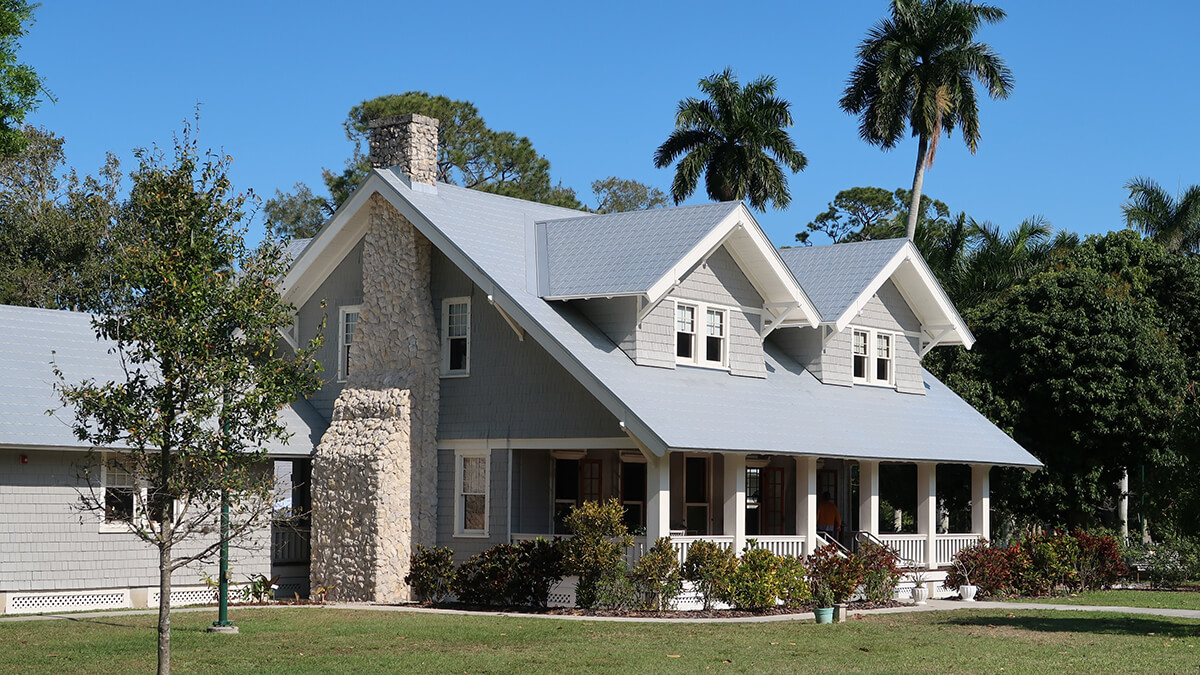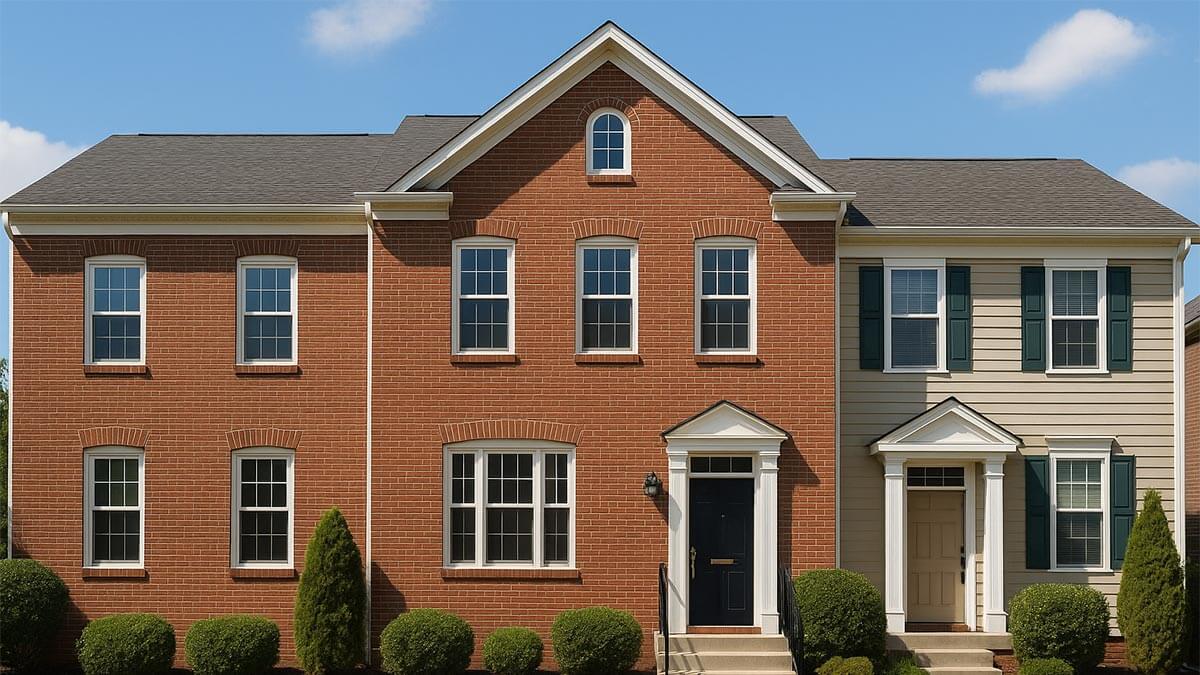
A townhouse typically sells for about $365,000 versus $439,000 for a single-family home, a gap of roughly $74,000 or 16 to 17 percent. Both property types allow individual ownership, but the attached structure, HOA obligations, and smaller outdoor footprint of a townhouse create a meaningfully different ownership experience than a detached home.
The townhouse vs single family home decision is rarely just about price. Monthly costs, HOA restrictions, noise exposure, and how each property type builds equity over time all factor in. Many buyers entering this process frame it as a townhouse vs house question first and a financial analysis second, when it needs to be both at once.
This guide covers the definitions and Census Bureau classifications, 2026 cost comparisons with side-by-side tables, space and privacy trade-offs, HOA fees and maintenance expectations, the pros and cons of buying a townhouse, appreciation rates by property type, lending distinctions, and a decision framework to help you choose between the two.
Townhouse vs. Single-Family
- What Is a Townhouse vs. a Single-Family Home?
- Townhouse vs. Single-Family Home Costs in 2026
- Space and Privacy: How the Two Compare
- HOA Fees and Maintenance: What to Expect
- What Are the Disadvantages of a Townhouse?
- Do Single-Family Homes Appreciate Faster?
- Is a Townhouse Considered a Single-Family Home?
- Is It Better to Buy a Townhouse or Single-Family?
- Which Property Type Fits Your Next Move?
- Frequently Asked Questions
Selling to Fund Your Next Home? Get competing cash offers and pick your own closing date.
No repairs, no commissions, no timing guesswork.
What Is a Townhouse vs. a Single-Family Home?
A townhouse shares one or more exterior walls with neighboring units and has its own private entrance; a single-family home is a detached structure that stands alone on its own lot. That distinction affects privacy, yard space, financing, and what you can legally do with the property for as long as you own it.
Both property types are individually owned. A townhouse is not an apartment or a condo. You own the unit, the land beneath it in most cases, and the interior. What you share with neighbors is the wall, and in some communities, the roof and exterior systems managed by a homeowners association.
What is a townhouse?
A townhouse is an attached home that shares one or two exterior walls with adjacent units. It typically spans two or three stories, has its own front door, and may include a small rear patio or courtyard. The vertical layout means living areas, bedrooms, and sometimes a garage are stacked across floors rather than spread horizontally.
In most townhouse arrangements, the owner holds fee simple ownership of both the unit and the land beneath it. This distinguishes a townhouse from a condo, where ownership is typically limited to the interior air space. The fee simple structure matters for resale value, financing, and what modifications you can make.
A townhouse is sometimes called a row house when units are attached in a continuous line along a street, particularly in older urban neighborhoods in the Northeast. For mortgage and zoning purposes, “townhouse,” “row house,” and “attached home” generally describe the same type of structure.
What is a single-family home?
A single-family home is a detached home that stands alone on its own parcel of land. The owner controls all four exterior walls, the full lot, and any structural changes subject only to local zoning rules. There are no shared walls with adjacent properties.
Single-family homes range from compact two-bedroom cottages to large four-plus-bedroom houses. The defining feature is separation from adjacent structures and full ownership of the surrounding land. This is what buyers typically mean when they compare a townhouse vs house, and what the term “detached home” refers to throughout this guide.
How the U.S. Census classifies each
Whether a townhouse counts as a single-family home depends on who you ask, and the answers vary enough to cause real confusion among buyers, agents, and lenders. The Census Bureau’s single-family housing definitions classify townhouses as single-family structures when each unit has ground-to-roof separation walls and independent utility connections. Under this federal definition, a townhouse with its own furnace, water hookup, and no shared floors or ceilings with the neighboring unit qualifies as a single-family home.
This is the criterion that separates a townhouse from a condo under federal classification. A condo unit typically shares floors and ceilings with neighbors above and below, placing it in the multi-family category regardless of how individual ownership is structured.
In everyday real estate listings, “single-family home” almost always refers to a detached structure specifically. So the same property type, a townhouse, may be described as a single-family structure by the Census Bureau and as something other than a single-family home by a listing agent or buyer’s lender. For mortgage and legal classification, the Census Bureau definition is the authoritative reference.
Fannie Mae treats most townhouses as planned unit development (PUD) properties, which triggers a project-level underwriting review that differs from the standard checklist for detached single-family homes. This has practical implications for buyers seeking a conventional loan on a townhouse.
Townhouse vs. Single-Family Home Costs in 2026
As of 2026, the median townhouse sells for approximately $365,000 compared to $439,000 for a single-family home, a gap of roughly $74,000 or 16 to 17 percent. The townhouse vs single family home cost comparison is the first calculation most buyers need to complete before evaluating any other factor.
The price gap is real, but the total monthly cost picture is more nuanced. Townhouse buyers pay HOA fees that single-family buyers in non-HOA communities skip entirely. Single-family buyers carry full exterior maintenance costs that HOA-covered townhouse owners do not. Accounting for both changes the comparison significantly.
Median purchase prices compared
According to NAR’s price data, the median existing single-family home price reached approximately $439,000 in early 2026, compared to approximately $365,000 for the median townhouse. This 16 to 17 percent spread has held consistently across multiple quarters and data sources.
In high-cost metros such as San Francisco, Boston, and Seattle, the gap between a detached home and an attached home often exceeds $200,000. In lower-cost Midwest and Southeast markets, the spread may be $20,000 to $40,000. The median home price figures above are national starting points, not guarantees for your specific market.
Monthly expense comparison table
Both tables below use the national median prices and an approximate 30-year fixed mortgage rate of 7 percent with 20 percent down. All figures are national estimates and will vary by market, credit score, and HOA.
Table 1: Feature Comparison
| Feature | Townhouse | Single-Family Home |
|---|---|---|
| Median purchase price (2026) | ~$365,000 | ~$439,000 |
| Typical square footage | 1,400, 2,000 sq ft | 1,800, 2,500+ sq ft |
| Lot/land ownership | Fee simple (small parcel) | Fee simple (~8,177 sq ft median lot) |
| Shared exterior walls | 1, 2 walls (attached) | None (detached) |
| HOA typical monthly fee | ~$135/month | $0 (unless in HOA community) |
| Exterior maintenance responsibility | HOA | Owner |
| Property tax basis | Lower (smaller lot value) | Higher (larger lot value) |
Based on NAR and Community Associations Institute data, 2026. Verify current figures before transacting.
Table 2: Estimated Monthly Expense Comparison
| Monthly Expense | Townhouse | Single-Family Home |
|---|---|---|
| Estimated mortgage (30-yr fixed, 20% down, ~7%) | ~$1,943 | ~$2,337 |
| HOA fee | ~$135 | $0 |
| Exterior maintenance reserve | $0 (HOA-covered) | ~$366, $732 |
| Interior maintenance reserve | ~$100, $150 | ~$100, $150 |
| Property taxes (est. at 1% annually) | ~$304 | ~$366 |
| Homeowner’s insurance | ~$100, $150 | ~$150, $200 |
| Utilities (estimated) | ~$150, $200 | ~$200, $300 |
| Total estimated monthly cost | ~$2,732, $2,882 | ~$3,519, $4,085 |
Estimates based on national median prices, 7% 30-year fixed rate, and 20% down payment. Actual costs vary by location and property condition. Verify current mortgage rates before transacting.
Property taxes and insurance
Property taxes on a townhouse tend to run lower than on a comparable single-family home because townhouse lots are smaller. Tax assessments include both the structure and the land; a smaller parcel lowers the land-value component of the bill.
Homeowner’s insurance for a townhouse may also run slightly lower than for a detached home, because the HOA’s master policy typically covers the exterior structure. Confirm exactly what the HOA policy covers before purchasing a separate policy. Coverage gaps for shared systems such as the roof or exterior siding are a common and costly discovery at claim time.
Space and Privacy: How the Two Compare
Single-family homes offer more usable space and full separation from neighbors. Townhouses trade some of that separation for a lower entry price, but the impact on daily living is more significant than the square footage numbers suggest on paper.
Square footage and lot size
A typical townhouse runs 1,400 to 2,000 square feet spread across two or three floors. A typical single-family home runs 1,800 to 2,500-plus square feet, usually on one or two floors. The numbers can overlap, but the daily experience is very different.
An 1,800-square-foot townhouse split across three stories functions differently than 1,800 square feet in a single-story ranch. In the townhouse, the kitchen, living room, and bedrooms sit on separate levels connected by stairs. The flow that makes a horizontal layout feel spacious is absent. This is a practical nuance that no headline square footage figure captures.
Lot size tells a clearer story. The national median single-family lot is approximately 8,177 square feet according to NAR data. A townhouse patio or courtyard typically runs 100 to 400 square feet. That gap is the most concrete way to understand the townhouse vs house outdoor space trade-off.
A scenario buyers commonly face: a $400,000 single-family home at 1,600 to 1,800 square feet on a full lot, versus a $378,000 townhouse at 1,800 to 1,900 square feet with a small rear patio. The townhouse offers more interior square footage at a lower price, but the trade-off is vertical living and no meaningful outdoor space.
Shared walls and noise
Shared walls are the privacy cost of townhouse living. Sound travels through shared walls in ways that detached home owners rarely experience: a neighbor’s television, a dog, children playing, or footsteps on stairs become part of your daily soundscape.
Multi-story townhouses add another dimension. In a three-story layout, sound travels not just through the shared side wall but through floors and ceilings as well. An upstairs neighbor getting up early is a noticeably different experience than living in a detached single-family home, and no amount of soundproofing fully eliminates it.
Outdoor space differences
A single-family home’s lot provides outdoor space for gardening, children’s play, pets, and outdoor entertaining. A townhouse typically limits outdoor space to a rear patio or courtyard, sometimes only a small front stoop.
For buyers with dogs, young children, or a strong preference for outdoor living, the outdoor space gap is often the deciding factor rather than the price gap. Townhouses near parks can offset the small-patio limitation to some degree, but they cannot replicate private yard space.
HOA Fees and Maintenance: What to Expect
HOA fees are among the most commonly cited reasons buyers hesitate on townhouses. Understanding what they cover, what they restrict, and how they compare to the direct maintenance costs of a single-family home helps you make an accurate total-cost comparison.
What HOA fees cover in a townhouse
The national median HOA fee reached $135 per month in 2025, up from $108 per month in 2019, according to CAI’s HOA fee data. That is a 25 percent increase over six years, and fees continue to trend upward.
For most townhouse communities, the monthly fee covers exterior siding, roof, gutters, shared landscaping, common area upkeep, and sometimes water and sewer. This means townhouse owners typically do not pay out-of-pocket for a new roof or exterior paint. The HOA handles it, funded by collective monthly dues.
Beyond regular fees, HOAs can levy special assessments: one-time charges for major repairs the reserve fund cannot cover. These range from $1,000 to $10,000 or more for items such as roof replacement, parking lot resurfacing, or exterior siding replacement across the full development. Before purchasing any townhouse, request the HOA’s reserve fund study. A reserve fund below 50 percent of its target funding level is a signal that a special assessment is likely within the next few years.
HOA restrictions to watch for
The CFPB’s HOA guidance recommends reviewing the CC&R (covenants, conditions, and restrictions) documents, bylaws, and recent board meeting minutes before committing to any purchase. Common restrictions in townhouse HOA communities include:
- Exterior paint color requires board approval
- Satellite dishes are prohibited or require prior approval
- Short-term rentals (Airbnb, VRBO) are prohibited in many communities
- Pet size or breed restrictions apply
- No commercial vehicles parked in front of the unit
- Fencing, garden structures, and landscaping changes require HOA approval
- No exterior structural modifications without board sign-off
These restrictions vary widely. Some HOAs are minimal; others regulate most visible aspects of the property. Read the CC&R documents before making an offer, not after.
Single-family maintenance costs
Single-family homeowners pay for exterior maintenance directly. The standard planning rule is 1 to 2 percent of the home’s value annually. On the $439,000 median home, that is $4,390 to $8,780 per year, or roughly $366 to $732 per month.
This covers roof repair and eventual replacement, siding, gutters, driveway, landscaping, and exterior painting. These costs are variable and can spike in any given year. A roof replacement alone on a 2,000-square-foot home typically runs $10,000 to $20,000. The single-family homeowner absorbs the full cost with no HOA to spread the burden.
The practical comparison is not whether you pay for maintenance but whether you pay directly and unpredictably (single-family) or indirectly and incrementally through monthly HOA dues (townhouse).
What Are the Disadvantages of a Townhouse?
Understanding the pros and cons of buying a townhouse begins with its five most significant limitations. Each one is real and worth weighing against the lower entry price before you decide.
-
Limited privacy and shared-wall noise. Shared walls allow sound to transfer from neighbors in ways detached home owners do not experience. In a three-story townhouse, noise travels through both the side wall and through floors and ceilings. A neighbor’s morning routine, pets, or late-night television becomes part of your daily life, and soundproofing reduces but does not eliminate it.
-
HOA fees and restrictions. The national median HOA fee was $135 per month in 2025, and fees have trended upward consistently. Beyond monthly dues, special assessments for major structural repairs can add $1,000 to $10,000 or more with limited advance notice. HOA rules commonly restrict exterior paint colors, short-term rentals, pet breeds, and structural modifications.
-
Less outdoor space. A typical townhouse patio or courtyard is 100 to 400 square feet. The national median single-family home sits on a lot of approximately 8,177 square feet. For buyers who want a yard for children, pets, gardening, or outdoor entertaining, this is a fundamental trade-off that price alone cannot resolve.
-
Multi-level layout with daily stair use. Most townhouses span two or three stories, placing the kitchen, bedrooms, and living areas on separate floors connected by stairs. For buyers with mobility concerns, young children who are difficult to manage on stairs, or plans to age in place, this layout becomes a meaningful long-term constraint.
-
Restricted expansion and customization. Shared walls physically prevent horizontal additions. HOA agreements typically prohibit exterior structural changes without board approval. Interior renovations are generally permitted, but adding square footage, building a garage, or constructing an accessory dwelling unit is restricted or impossible. Single-family homeowners face far fewer constraints on how they expand or modify their property.
Do Single-Family Homes Appreciate Faster?
Generally yes. Single-family homes have historically appreciated faster than townhouses, but the gap depends on your local market and the time period you measure. The question “do single-family homes appreciate faster than townhouses” produces conflicting answers across data sources because the answer is yes nationally over the long term, but sometimes no locally, and because short-term data and long-term data tell different stories.
The full picture requires looking at multiple time horizons and the mechanism that drives the gap.
Historical appreciation rates compared
Single-family homes have averaged roughly 6 to 9 percent annual appreciation historically, compared to 3 to 5 percent for townhouses and condos. This long-term pattern appears consistently across industry analyses and government price indices.
More recent data shows how the gap plays out over shorter windows. April 2024 figures showed single-family home values up 6.1 percent year-over-year versus townhouses at 4.8 percent. A separate Zillow analysis covering September 2024 through September 2025 showed single-family values up 0.2 percent while condo values declined 1.5 percent in the same period.
The FHFA House Price Index is the most authoritative government-sourced view of appreciation by property type and metro area. Pull the current-year data before making long-term appreciation assumptions for your specific market.
| Time Period | Single-Family | Townhouse/Condo |
|---|---|---|
| Historical annual avg. (long-term) | ~6, 9% | ~3, 5% |
| April 2024 (year-over-year) | +6.1% | +4.8% |
| Sept. 2024 to Sept. 2025 | +0.2% | -1.5% |
Sources: Industry analysis and Zillow market data (Sept. 2024 to Sept. 2025 figures). Verify current figures via the FHFA House Price Index before transacting.
How appreciation compounds into equity over time is covered in depth in our guide to calculating your home equity.
Why land value drives the gap
The gap in home appreciation rate between single-family homes and townhouses comes down to land. A single-family home includes a larger land component, and land appreciates more reliably than the structure itself. The structure requires maintenance and eventually needs replacement; the land does not.
In most markets, the lot is where equity accumulates most consistently over time. Townhouses sit on smaller parcels, which means a smaller share of the purchase price represents land value. Over a 10 to 15-year hold, this difference compounds in the single-family homeowner’s favor.
The investment implications of this go beyond lifestyle preference. For buyers thinking about ownership as both a home and a wealth-building tool, our article on real estate investment risks covers how property type affects long-term returns in more depth.
When townhouses outperform
In supply-constrained markets on the Northeast and West coasts, townhouses have sometimes narrowed the appreciation gap or outperformed single-family homes over specific periods. In metro areas where detached single-family homes regularly sell for $700,000 to $1 million or more, townhouses represent the most affordable path to homeownership and attract sustained buyer demand.
Strong demand at a lower price point can produce competitive appreciation in percentage terms over short windows. This does not erase the long-term land-value advantage of single-family homes, but it makes the appreciation question genuinely market-specific. In Boston, Philadelphia, or the Bay Area, a well-located townhouse may build equity faster over a five-year window than a single-family home in an outer suburb.
Is a Townhouse Considered a Single-Family Home?
It depends on the context. The U.S. Census Bureau classifies townhouses as single-family homes when each unit has ground-to-roof walls and independent utility connections. In everyday real estate listings, “single-family home” typically refers to a detached house, so the same property may be described two different ways depending on who you ask.
For buyers, the practical answer is: yes, for mortgage purposes in most cases. In everyday conversation and listing searches, the answer is usually no, because most people use “single-family home” to mean “detached.”
U.S. Census Bureau definition
The Census Bureau’s housing unit definitions classify a townhouse as a single-family structure when it meets two criteria: each unit has ground-to-roof separation walls with no shared floor or ceiling with the adjacent unit, and each unit has independent utility hookups. This is the standard that separates a townhouse from a condo under federal classification.
A condo unit typically shares floors and ceilings with neighbors above and below, placing it in the multi-family category even when individually owned. A townhouse, by Census Bureau definition, is single-family because the separation between units is vertical (wall-to-wall) rather than horizontal (floor-to-ceiling stacking). This is why townhouses qualify for single-family mortgage products when condos require a separate project approval process.
How lenders classify townhouses
Lenders do not uniformly treat townhouses as detached single-family homes, even when the Census Bureau does. Fannie Mae’s PUD guidelines classify most townhouses as planned unit development properties, which triggers a project-level review requirement under certain conditions. This is a distinct underwriting track from the standard detached single-family process and can affect what documents the lender requires before approving the loan.
FHA loans are available for townhouses in FHA-approved developments with as little as 3.5 percent down, the same floor as for detached single-family homes. The critical step is confirming the development appears on the FHA approved list before applying. An unapproved development disqualifies the loan regardless of the buyer’s credit or income.
VA loans are similarly available for eligible townhouses. Confirm the specific development’s approval status with your lender before making an offer on any townhouse.
Zoning and local definitions
Local zoning adds another layer of classification. Some municipalities zone attached townhouse rows as “attached residential” or “multi-family” rather than single-family. This affects renovation permits, accessory dwelling unit legality, and short-term rental rules independent of what the HOA allows.
A townhouse zoned as multi-family in a city with strict short-term rental restrictions may be prohibited from short-term rental use regardless of HOA policy. Review local zoning alongside the CC&R documents before purchasing, especially if rental income is part of your ownership plan.
Is It Better to Buy a Townhouse or Single-Family?
Neither is universally better. The right choice depends on your budget, the specific market you are buying in, and how long you plan to stay. Asking “is it better to buy a townhouse or single-family” is really asking which set of trade-offs fits your situation, not which property type is objectively superior.
The townhouse vs single family home comparison is most useful when applied to your specific numbers and priorities rather than national averages alone.
Decision framework: 5 questions to ask
Apply these five questions to your situation before choosing:
-
Can you absorb the roughly $74,000 upfront premium for single-family, plus higher property taxes and exterior maintenance? The price gap is real, but so are the ongoing cost differences. Run both scenarios through the monthly expense table above using your local property tax rate before deciding.
-
Are you comfortable with at least $135 per month in HOA fees you cannot negotiate, plus special assessment risk? HOA fees trend upward and are not optional once you close. Budget for them as a permanent monthly expense, not a transitional one.
-
Do you need privacy, outdoor space, or the freedom to renovate? If yes to any of these three, a single-family home is likely the better fit. A townhouse limits all three by its physical and legal structure.
-
Are you staying five or more years? Shorter holds favor townhouses, where the lower entry price and HOA-managed exterior reduce financial exposure. Do single-family homes appreciate faster than townhouses over long holds? Yes, in most markets, and the margin grows with time.
-
Does your target market have detached single-family homes in your price range? In high-cost metros, a townhouse may be the only realistic path to ownership. Where single-family homes are available at the same price, the decision calculus shifts entirely.
How to Choose Between a Townhouse and a Single-Family Home
- Calculate your true total monthly cost for each option. Add the estimated mortgage payment, HOA fee (budget $135 per month as a floor for most townhouses, $0 for most single-family homes unless in an HOA community), property taxes, homeowner’s insurance, and maintenance reserve (1 to 2 percent of purchase price annually for single-family exterior maintenance; for townhouses, the HOA covers the exterior, but budget for interior repairs). Write the monthly totals side by side before comparing anything else.
- Rank your top three priorities in writing. Privacy, outdoor space, low maintenance burden, access to shared amenities, and purchase price will rank differently for each buyer. If privacy or outdoor space is first on your list, a single-family home will likely serve you better. If purchase price is first, a townhouse is typically $74,000 cheaper at the national median.
- Review HOA documents before falling in love with a listing. For any townhouse under serious consideration, request the CC&R documents, the last 12 months of board meeting minutes, and the reserve fund study. A reserve fund below 50 percent of its target is a signal of likely special assessments in the coming years. Do this before making an offer, not after.
- Research 5-year and 10-year appreciation trends in your specific ZIP code. National averages (single-family roughly 6 to 9 percent historically, townhouses roughly 3 to 5 percent) can be misleading at the local level. Pull the last five years of median sold prices by property type in your target ZIP using MLS data or the FHFA metro-level price index. In supply-constrained metros, townhouses sometimes narrow or close the appreciation gap.
- Apply the time-horizon test. If you plan to stay fewer than five years, the higher transaction costs of buying a single-family home may not be recouped through appreciation. Townhouses can make more financial sense for shorter holds. For a 10-plus-year horizon, the land-value component of single-family ownership compounds more significantly in most markets.
- Make the final decision using a written four-column comparison. Columns include monthly cost difference, estimated 10-year equity build using your local appreciation rate from Step 4, your priority score from Step 2, and HOA risk assessment from Step 3. The property type that scores better on three of the four columns is your answer.
Before making an offer on either property type, understanding contingent vs. pending status helps you read the competitive landscape accurately. If you are also managing a simultaneous home sale, buying a house contingent on selling covers the logistics step by step.
Who should buy a townhouse
A townhouse is a strong fit for:
- First-time homebuyers who need a lower entry price to get into ownership, especially in markets where detached single-family homes are priced at $600,000 or more
- Empty nesters downsizing from a larger single-family home who want reduced exterior maintenance without the restrictions of a condo
- Buyers in high-cost metros where townhouses are the most affordable homeownership option available
- Buyers with shorter time horizons (three to seven years) who want to build equity without taking on full exterior maintenance costs
HUD’s FHA requirements cover specific eligibility criteria for first-time buyers using FHA financing on a townhouse within a planned unit development.
The pros and cons of buying a townhouse lean positive for buyers in this group. Lower price, lower exterior maintenance responsibility, and access to shared amenities outweigh the privacy and space trade-offs when budget is the binding constraint.
Who should buy a single-family home
A single-family home is the better fit for:
- Families needing a yard for children, pets, or outdoor living
- Buyers with a 10-plus-year horizon who want the land-value component of appreciation to compound over time
- Buyers who plan to renovate or expand and need the freedom to modify the exterior without HOA approval
- Buyers who prioritize privacy and are not willing to share walls, exterior systems, or community rules with adjacent neighbors
Once you have decided on a property type, understanding the purchase process from offer to close matters just as much. 16 steps to closing walks through what happens between an accepted offer and the closing table.
Evaluating the pros and cons of buying a townhouse versus a single-family home comes down to applying the five framework questions above to your actual budget, market, and life stage rather than relying on national medians alone.
Which Property Type Fits Your Next Move?
The townhouse vs house decision comes down to four variables: how much you can spend upfront, how long you plan to stay, how much you value privacy and outdoor space, and how your target market prices each property type.
At the national level, townhouses offer a $74,000 lower entry price, lower exterior maintenance costs, and access to shared amenities. Single-family homes offer full land ownership, no HOA restrictions, more outdoor space, and a historically stronger home appreciation rate driven by the land-value component.
The answer to “is it better to buy a townhouse or single-family” depends entirely on your market, budget, and how long you plan to stay. The right answer is the one that fits your actual numbers, the realities of your local market, and how you want to live for the next five to ten years.
If you are selling your current home to fund either purchase, the timing is usually the hardest part. You need the sale to close soon enough to free up equity, but not so early that you are displaced before finding the right property. Through iBuyer.com, you submit your address and receive competing cash offers from vetted buyers, without listing on the MLS, making repairs, or paying agent commissions. You choose the closing date, typically 7 to 30 days out, which means you can make a clean, non-contingent offer on the home you decide on. Compare your offers at iBuyer.com.
Skip the Listing, Move on Your Timeline Cash offers from vetted buyers let you close in 7 to 30 days.
No agent fees, no contingencies, no open houses.
Frequently Asked Questions
A townhouse shares one or more walls with adjacent units; a single-family home stands detached on its own lot. Both are individually owned properties, but the attached structure means townhouse owners typically have less outdoor space, more shared-wall noise, and exterior modifications subject to HOA approval. Single-family homeowners control all four exterior walls, the full lot, and any structural changes they want to make.
Yes, the U.S. Census Bureau classifies townhouses as single-family structures when each unit has ground-to-roof walls and independent utility connections. This is why townhouses qualify for single-family mortgage products through most lenders. In everyday real estate listings, “single-family home” typically refers to a detached house, so the same property type may be described two different ways depending on context. For mortgage and legal classification, the Census Bureau definition applies.
Neither is universally better; townhouses typically cost $70,000 to $80,000 less upfront, while single-family homes offer more space, privacy, and historically stronger appreciation. The best choice depends on your budget, life stage, and time horizon. Buyers in high-cost metros often find townhouses are the only affordable path to ownership. Buyers with a 10-plus-year horizon who need outdoor space typically build more equity in a single-family home.
Townhouses offer reduced privacy from shared walls, HOA fees averaging $135 per month nationally in 2025, and significantly less outdoor space than detached single-family homes. HOA restrictions can also limit exterior modifications, pet ownership, and short-term rentals. Multi-story layouts with stairs throughout can become problematic for aging owners or anyone with mobility limitations. Special HOA assessments for major repairs can add several thousand dollars in unexpected costs with limited advance notice.
Generally yes; single-family homes have averaged roughly 6 to 9 percent annual appreciation historically, compared to 3 to 5 percent for townhouses. The gap comes from land value: single-family homes sit on larger lots, and land tends to build equity more reliably than the structure itself. April 2024 data showed single-family values up 6.1% versus townhouses at 4.8%. In supply-constrained coastal markets, townhouses have sometimes narrowed this gap because they represent the most affordable ownership option with strong buyer demand.
Nationally, the median single-family home costs about $439,000 versus $365,000 for a townhouse, a gap of roughly $74,000 or 16 to 17 percent. This gap varies significantly by market. In high-cost metros, the premium for a detached single-family home can exceed $200,000. In lower-cost Midwest or Southeast markets, the spread may be $20,000 to $40,000. The total monthly cost difference narrows when HOA fees are factored into the townhouse calculation.
Most townhouses belong to a homeowners association; the national median HOA fee was $135 per month in 2025, up from $108 per month in 2019. HOA fees vary widely depending on the development and amenities, from under $100 to over $500 per month. Beyond monthly dues, HOAs can levy special assessments for major repairs to shared structures. Before purchasing a townhouse, review the HOA’s reserve fund study and the last 12 months of board meeting minutes.
The HOA typically manages exterior maintenance including the roof, siding, and landscaping, while the owner handles all interior repairs and systems. This division varies by HOA; some cover the full exterior including windows and doors, others cover only the roof and common areas. Review the CC&R documents carefully before purchase to confirm exactly what is and is not the owner’s responsibility. Ambiguity here is a common source of disputes after closing.
Most townhouse owners hold fee simple title, meaning they own both the structure and the land parcel beneath it. This is what distinguishes a townhouse from a condo, where ownership is typically limited to the interior air space. Fee simple ownership means you are responsible for your portion of the lot and can, within HOA limits, landscape or improve it. Always verify the ownership structure in the title documents before closing.
Yes, townhouses qualify for conventional, FHA, and VA loans, though lenders apply separate underwriting guidelines from those used for detached single-family homes. Fannie Mae classifies most townhouses as planned unit development properties, which triggers a project-level review requirement in some cases. FHA loans are available for townhouses in FHA-approved developments with as little as 3.5% down. Confirm the property’s HOA is on the FHA-approved list before applying, as unapproved developments disqualify the loan.
Townhouse owners hold fee simple title to both the unit and the land; condo owners typically hold title only to the interior air space. This ownership difference is the key factor in any condo vs townhouse comparison. Townhouses generally have their own entrance and no shared floors or ceilings with neighbors, while condos may be stacked vertically. Condo HOA fees are often higher because the association covers a larger share of the building, and the mortgage approval process for condos is more complex than the PUD review for townhouses.
Townhouses can suit young families, but shared walls create noise exposure and outdoor space is typically limited to a small patio or courtyard. Multi-story layouts with stairs throughout are impractical for toddlers and become a longer-term consideration as owners age. Families who need a yard for play typically find detached single-family homes more functional. In urban markets where single-family homes are financially out of reach, a townhouse near a park can be a workable compromise.
Townhouses typically carry lower property tax bills because they sit on smaller lots with lower assessed land values than detached single-family homes. Property taxes are calculated on assessed value, which includes both the structure and the land. Because townhouse lots are smaller, the land component of the assessment is lower, pulling the total tax bill down. In dense urban markets where land per square foot is expensive, this gap can narrow substantially.
A townhouse cannot expand horizontally because shared walls prevent it, and most HOA agreements prohibit exterior structural changes without board approval. Vertical additions may be structurally possible in some cases but are restricted in most communities and always require HOA approval. Interior renovations are generally permitted without HOA involvement. Single-family homeowners face far fewer constraints and can typically add square footage, build garages, or add accessory dwelling units where local zoning permits.

Reilly Dzurick is a licensed real estate agent with over six years of experience and a member of the iBuyer.com Market Insights Team, covering national trends in home selling and the evolving iBuyer landscape. Her firsthand experience working with buyers and sellers gives her a practical perspective on how these platforms impact real homeowners. She holds a degree in Public Relations, Advertising, and Applied Communication.