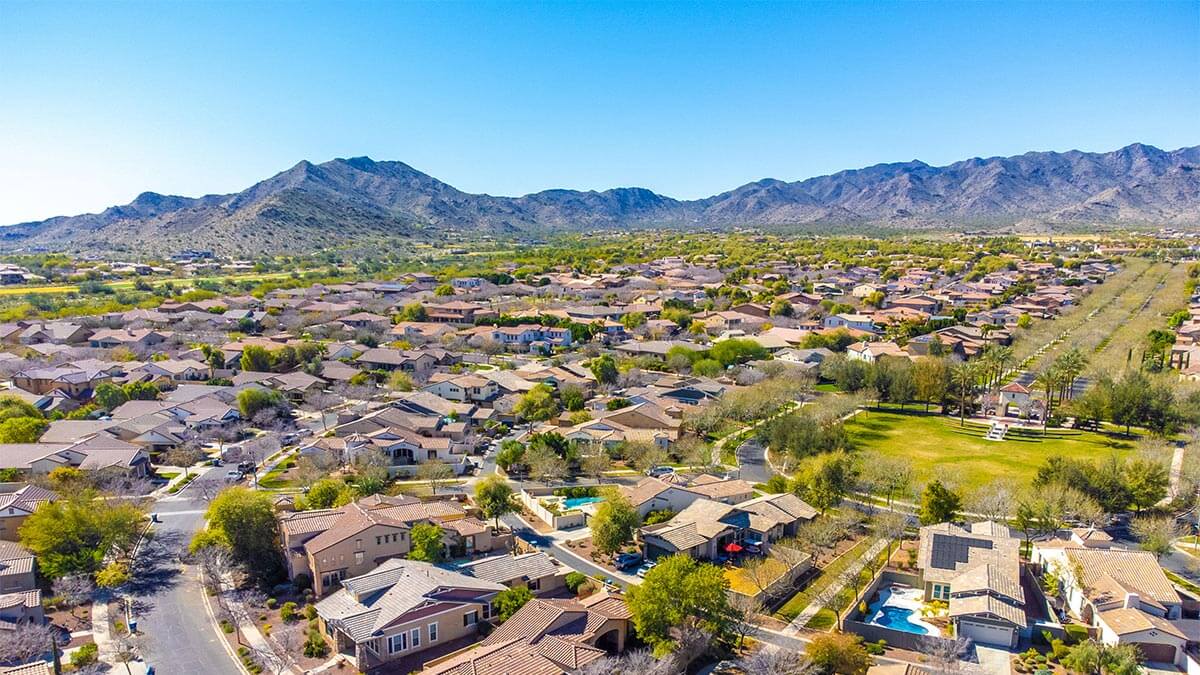
The safest places to live in Arizona are suburban communities like Gilbert, Oro Valley, Surprise, and Queen Creek, all recording violent crime rates well below both state and national averages. Gilbert is recognized as one of the safest large cities in the entire United States, while Oro Valley, north of Tucson, consistently posts one of the lowest violent crime rates anywhere in the state.
Arizona’s overall crime picture is uneven. Phoenix carries a violent crime rate of 799.6 per 100,000 residents, pulling the statewide average above the national norm. The suburbs surrounding both Phoenix and Tucson show a very different picture. Cities like Queen Creek, Sahuarita, and San Luis record figures that rival the safest communities in any Sun Belt state.
This guide covers 2026 safety rankings for Arizona’s 10 safest cities, neighborhood-level data for the safest neighborhoods in Phoenix, a direct Phoenix versus Scottsdale comparison, affordability context for the $3,000-a-month question, and regional guidance for anyone planning an Arizona relocation.
Safest Places to Live
- Safest Places to Live in Arizona: 2026 Rankings
- 10 Safest Cities in Arizona: City-by-City Profiles
- Safest Neighborhoods in Phoenix and the East Valley
- Is Phoenix or Scottsdale Safer?
- What Is the Nicest Area to Live in Arizona?
- Can You Live in Arizona on $3,000 a Month?
- Why Are People Moving Out of Arizona?
- Arizona Safety by Region: A Quick Reference
- Choosing a Safe Arizona Neighborhood: What to Avoid
- Find the Safest Neighborhoods in Your Arizona City
- Frequently Asked Questions
Moving to a Safer Arizona City? Sell your current home in 7-30 days — no repairs, no agent commission needed.
Multiple cash offers, your closing date, no obligations.
Safest Places to Live in Arizona: 2026 Rankings
The safest cities in Arizona in 2026 cluster in two geographic corridors: the East and Northwest Valley suburbs around Phoenix and the master-planned communities north and south of Tucson. SafeWise’s 2026 Arizona safety rankings place Oro Valley, Queen Creek, and Gilbert among the statewide leaders. NewHomeSource places Paradise Valley first based on a methodology that incorporates property exclusivity and resident safety perception alongside raw crime data. Both lists converge on the same core group of communities.
Crime rates in Arizona span one of the widest ranges in the country, from Phoenix metro figures that rival the most dangerous large cities in the Sun Belt to suburban numbers that sit well below the national average. Understanding that range is the essential starting point for any Arizona relocation decision.
How Arizona’s safety rankings are measured
Most Arizona safety rankings draw on two standard measures from the FBI Uniform Crime Report: violent crime per 100,000 residents and property crime per 100,000 residents. Publishers like SafeWise and SafeHome supplement that raw data with resident surveys and livability scores, which explains why rankings can differ by a few positions between sources. The comparison table below sorts cities by violent crime per 100,000 residents as the primary metric, consistent with how the FBI Uniform Crime Report presents the data.
Arizona vs. national crime averages in 2026
Comparing crime rates in Arizona to the national benchmark reveals a state of extremes. The statewide violent crime rate runs above the U.S. national average, driven by concentrated volumes in the Phoenix metro core. Crime rates in Arizona’s safest suburbs, however, fall under 200 per 100,000 residents, with several communities below 100 per 100,000. That positions Arizona’s top-ranked suburbs well below the national norm and makes city and neighborhood selection the most consequential single decision for any buyer or renter moving to the state.
Arizona’s 10 Safest Cities: 2026 Comparison
| City | Region | Violent Crime per 100K | Property Crime per 100K |
|---|---|---|---|
| Paradise Valley | Northeast Phoenix metro | 24 | 350 |
| San Luis | Yuma County | 73 | 647 |
| Oro Valley | North Tucson | 81 | 1,143 |
| Sahuarita | South Tucson | 86 | 958 |
| Queen Creek | Southeast Valley | 93 | 1,048 |
| Gilbert | East Valley | 104 | 1,458 |
| Marana | Northwest Tucson | 113 | 1,298 |
| Surprise | Northwest Valley | 127 | 1,388 |
| Buckeye | West Valley | 139 | 1,617 |
| Florence | Southeast Phoenix metro | 153 | 1,193 |
Source: SafeWise 2026 Arizona safety rankings; SafeHome current Arizona crime data. Verify per-100,000 figures against the current SafeWise report before transacting.
10 Safest Cities in Arizona: City-by-City Profiles
Each profile below opens with a direct safety assessment you can read in isolation. Per-100,000 crime figures are drawn from SafeWise 2026 and Arizona violent and property crime comparisons from SafeHome.
Gilbert: safest large city in Arizona
Gilbert is one of the safest large cities in the United States, with a violent crime rate well below both Arizona and national averages. Located in East Valley Arizona southeast of Phoenix, it combines low crime with highly rated public schools, dozens of community parks, and a thriving restaurant and dining scene. Gilbert’s population has surpassed 280,000 and it has maintained crime metrics that outperform most cities half its size. For families relocating to the Phoenix area, Gilbert Arizona belongs at the top of any short list for safety, schools, and overall livability. For broader neighborhood-level context across the Tucson side of the state, see best neighborhoods in Tucson.
Oro Valley: safest near Tucson
Oro Valley sits north of Tucson against the Santa Catalina Mountains with a violent crime rate among the lowest in the state. It offers master-planned community zoning, access to Tucson’s medical and university infrastructure, and an outdoor lifestyle built around Catalina State Park and the adjacent mountain trail system. Robson Communities has named it the most livable retirement town in the West, a designation cited directly in the Google AI Overview for this topic. For buyers looking at Tucson suburbs, Oro Valley consistently ranks first for combined safety and amenities at a reasonable price point.
Queen Creek: family-friendly and rural-suburban
Queen Creek, in the Southeast Valley, consistently reports very low violent crime and high livability scores. It functions as a rural-suburban hybrid with lower density than Gilbert or Chandler, strong public school options, and growing retail access via the San Tan Valley corridor. Queen Creek ranked #1 best place to live in Arizona in the U.S. News 2025-2026 rankings, a distinction driven primarily by its safety profile and resident satisfaction scores. Its property crime rate per 100,000 residents is among the lowest in the entire Phoenix metro.
Surprise: fastest-growing safe city
Surprise Arizona is one of the fastest-growing cities in the state and, unusually, one of the safest. Located in the Northwest Valley, it anchors a corridor of master-planned community developments built around organized recreation and low-density residential zoning. SafeWise’s 2026 rankings placed it in the statewide top 10 safest cities. White Tank Mountain Regional Park provides extensive hiking and cycling access on the city’s western edge. Entry-level home prices run lower here than in Gilbert or Scottsdale, making Surprise one of the few safe Arizona cities that still offers meaningful affordability headroom for buyers moving from higher-cost markets.
Sahuarita: quiet growth south of Tucson
Sahuarita sits south of Tucson in the Santa Cruz Valley and records a fraction of the crime rates found in larger neighboring cities. It is among the fastest-growing communities in Arizona while maintaining low violent and property crime figures. The town’s economy links to the Freeport-McMoRan Sierrita copper mine and a growing logistics and distribution sector. For buyers examining Tucson suburbs who also need to stay within a moderate budget, Sahuarita offers safety metrics that compete with Arizona’s best East Valley communities at price points well below the Phoenix metro.
San Luis: low violent crime in Yuma County
San Luis is a border city in Yuma County that earns consistent placement in SafeWise’s statewide top 10 for one reason: its violent crime rate per 100,000 residents is among the lowest in Arizona. That may seem counterintuitive for a community along the Mexican border, but San Luis’s close-knit community structure and active local policing have kept crime figures impressively low. Property crime rates are also well below the state average. Its remote location from Phoenix and Tucson amenities is the primary trade-off for most relocating families.
Buckeye: affordable and safe West Valley
Buckeye appears in SafeWise’s 2026 top 10 safest Arizona cities and has maintained low per-capita crime rates despite being one of the fastest-growing cities in the country over the past decade. Located in the West Valley, it offers significantly lower home prices than East Valley comparables like Gilbert or Queen Creek. Growth has brought new retail, schools, and infrastructure without proportional increases in crime, making Buckeye one of the more overlooked safe options for buyers priced out of the East Valley’s most desirable communities.
Marana: master-planned safety northwest of Tucson
Marana anchors the northwest Tucson corridor with consistent SafeWise top-10 placement and a master-planned community structure that directly supports low crime through maintained lighting, gated entries, and organized neighborhood watch programs. Located along Interstate 10 between Tucson and Casa Grande, it offers access to Tucson’s job market and healthcare system at lower prices and lower crime rates than Tucson proper. Retirees and young families moving to the Tucson area increasingly include Marana on their short list alongside Oro Valley.
Paradise Valley: most exclusive enclave
Paradise Valley records a violent crime rate of just 24 per 100,000 residents, among the lowest in the entire state and dramatically below Scottsdale’s 152.5 per 100,000. Located northeast of Phoenix between Scottsdale and the Phoenix Mountain Preserve, it features large-lot estates, upscale resort properties, and mountain views on nearly every street. Median home prices exceed $2 million. The town’s small population (approximately 15,000 residents), active police presence, and estate-residential zoning structure explain its exceptional safety profile. For buyers without an eight-figure budget, adjacent Paradise Valley Village inside Phoenix city limits offers similar safety metrics at substantially lower price points.
Florence: historic town, low crime
Florence sits southeast of the Phoenix metro and offers a violent crime rate and cost of living both below the national average. It is a historic Arizona town with a downtown district dating to the territorial period, and it has attracted residents seeking affordability combined with reasonable safety within commuting range of the Phoenix metro via US-60 and US-79. Florence is not a master-planned community or resort enclave, but it delivers the fundamentals: low violent crime and affordable housing within roughly 60 miles of Phoenix’s employment core.
Safest Neighborhoods in Phoenix and the East Valley
Phoenix as a city carries a violent crime rate of 799.6 per 100,000 residents, but the safest neighborhoods in Phoenix post figures dramatically lower than that city average. According to safest Phoenix neighborhoods by crime data from Accident Justice (updated June 2026), the lowest-crime zones inside city limits include Ahwatukee Foothills, North Gateway, Deer Valley, Desert View, and Paradise Valley Village. For a full quality-of-life breakdown across the metro, see best neighborhoods in Phoenix.
Understanding which are the safest neighborhoods in Phoenix requires separating city-level statistics from neighborhood-level data. The same principle applies across every Arizona metro: the city average masks wide variation at the ZIP-code level.
Ahwatukee Foothills
Ahwatukee Foothills sits at the southern tip of Phoenix against South Mountain Preserve, functionally separate from the rest of the city in both geography and crime profile. It records figures closer to suburban Chandler or Gilbert than to central Phoenix. The neighborhood runs predominantly owner-occupied, with strong HOA structures, good public schools, and direct I-10 freeway access. It is the most consistently cited safe neighborhood in Phoenix across crime data sources and resident surveys.
Desert Ridge
Desert Ridge, in north Phoenix near the Loop 101 and Tatum Boulevard intersection, is a master-planned community built around a large retail and dining hub. Its crime rates are among the lowest within Phoenix city limits. Several major corporate campuses along the north Loop 101 corridor support strong property values and community investment in infrastructure and safety services.
North Central Phoenix
North Central Phoenix, centered on the Central Avenue corridor north of Camelback Road, is one of the city’s most established residential neighborhoods. It features historic homes on large lots and an active neighborhood association network. Violent crime rates here fall well below the Phoenix city average, and the area draws long-term residents who value urban walkability alongside above-average safety for an intra-city location.
Paradise Valley Village
Paradise Valley Village is a Phoenix neighborhood distinct from the independent Town of Paradise Valley. Located in the northeast quadrant of the city near Scottsdale’s eastern border, its crime figures approach Scottsdale-level metrics rather than broader Phoenix averages. It offers significantly lower price points than Scottsdale proper while delivering a comparable safety profile for buyers who want East Valley safety at a West-side budget.
Arcadia and Biltmore
Arcadia and Biltmore are adjacent upscale neighborhoods straddling the Phoenix-Scottsdale boundary near 44th Street and Camelback Road. Both record very low violent crime rates for intra-city Phoenix neighborhoods. Arcadia is known for citrus groves, ranch-style homes, and walkable streets. Biltmore centers on the historic Arizona Biltmore resort corridor. Together they represent some of the highest property values inside Phoenix city limits alongside the city’s lowest neighborhood-level crime figures.
Is Phoenix or Scottsdale Safer?
Is Phoenix or Scottsdale safer? The data answers that question clearly. Scottsdale is significantly safer than Phoenix, with a violent crime rate of 152.5 per 100,000 residents against Phoenix’s 799.6 per 100,000, a gap of more than five to one. On property crime, Scottsdale records 1,875.3 per 100,000 compared to Phoenix’s 2,325.3 per 100,000.
Total volume confirms the gap. Phoenix recorded 13,296 violent crimes in 2024, including 139 murders. Scottsdale recorded roughly 380 violent crimes in the same period. Phoenix is a much larger city, but even on a per-capita basis the difference remains stark. Scottsdale’s safety score is 75 out of 100 compared to Phoenix’s 59 out of 100.
Crime rates compared side by side
| Metric | Phoenix | Scottsdale |
|---|---|---|
| Violent crime per 100K | 799.6 | 152.5 |
| Property crime per 100K | 2,325.3 | 1,875.3 |
| Total violent crimes (2024) | 13,296 | ~380 |
| Safety score (out of 100) | 59 | 75 |
| Crime index (100 = safest) | 9 | 21 |
Source: Scottsdale’s official crime statistics; Phoenix figures per FBI 2024 UCR data.
One nuance worth noting: Scottsdale reported a cluster of residential burglaries in neighborhoods adjacent to golf courses between November 2023 and January 2024, with 21 incidents in that window. Scottsdale’s overall figures remain far below Phoenix, but evaluating specific neighborhoods within any city still matters.
Scottsdale-level safe spots inside Phoenix
Several Phoenix neighborhoods approach Scottsdale’s safety profile. Ahwatukee Foothills, Desert Ridge, and Paradise Valley Village each score crime indices meaningfully above Phoenix’s citywide 9 out of 100 figure. If you are evaluating Phoenix for budget reasons but want Scottsdale-comparable safety, those three neighborhoods are the strongest candidates within city limits.
What Is the Nicest Area to Live in Arizona?
“Nicest” in Arizona depends on what you are optimizing for. Queen Creek leads on overall livability scores, Scottsdale leads on luxury and amenities, and Gilbert leads for family-oriented suburban life. Each draws a different buyer profile and comes with meaningfully different price points.
Scottsdale: luxury, golf, and upscale amenities
Scottsdale is Arizona’s leading destination for luxury living. The city encompasses the McDowell Sonoran Preserve with over 200 miles of hiking trails, dozens of top-rated golf courses, a concentrated retail and dining district along Scottsdale Road, and world-class resort hotels. The median home price in Scottsdale approaches $999,999 based on Realtor.com data. For buyers with the budget, Scottsdale combines a low violent crime rate, high-end lifestyle, and professional prestige in one location.
Gilbert and Chandler: top-ranked for families
Gilbert and Chandler both rank among the best places to live in Arizona for families with children. Both cities occupy the East Valley with highly rated school districts, low violent crime, abundant parks and recreation, and strong employment corridors. Chandler’s median home price sits at approximately $555,000, substantially below Scottsdale. Gilbert runs slightly higher. Both cities appear consistently in U.S. News’s annual best-places rankings for Arizona and in SafeWise’s statewide safety reports.
Queen Creek: ranked #1 by U.S. News in 2026
Per U.S. News best places to live in Arizona 2026, Queen Creek holds the #1 position in the state for 2025-2026, reflecting a combination of low crime, strong schools, high resident desirability scores, and quality-of-life metrics. Among the best places to live in Arizona that balance safety, affordability, and livability, Queen Creek is the strongest all-around answer for buyers who do not require urban density or resort-level amenities.
Tucson-area options: Oro Valley and Marana
For buyers open to the Tucson area, Oro Valley and Marana offer quality-of-life scores comparable to top Phoenix suburbs at meaningfully lower price points. Oro Valley provides mountain views, resort-style recreation, and one of the state’s lowest violent crime rates. Marana offers newer construction at slightly lower prices with similar safety metrics and access to Tucson’s hospital system and University of Arizona campus within 20 to 30 minutes.
Can You Live in Arizona on $3,000 a Month?
Yes, but $3,000 a month is a tight budget in most of Arizona. Tucson and a handful of smaller cities are the most realistic options at that income level.
Cost of living in Arizona vs. the U.S. average
The cost of living in Arizona runs 5 to 8% above the U.S. average, according to PayScale data. Housing is the primary driver, running 14 to 22% above the national average depending on the market. The statewide average rent sits at approximately $1,562 per month. Arizona’s living wage is calculated at roughly $23.40 per hour (approximately $4,056 per month), placing a $3,000 monthly budget below the broadly accepted living wage for the state.
Most affordable safe cities in Arizona
Tucson suburbs and smaller metro areas offer the most practical path to safe living within a $3,000 monthly budget. According to average rent by city in Arizona from RentCafe, a one-bedroom apartment in Tucson averages approximately $903 per month, well below Phoenix-area one-bedroom averages. Sierra Vista, southeast of Tucson, is another viable option with similarly low rents and crime rates below the state average. For a complete list of budget-friendly options, see cheapest places to live in Arizona.
What $3,000/month actually covers in Tucson
Total monthly expenses in Tucson run approximately $2,821 for a single person, covering a one-bedroom apartment, food, transportation, and utilities at a modest but functional standard. Sierra Vista runs close to that at approximately $2,905 per month. Both cities offer crime rates well below the state average. Phoenix-area communities on $3,000 a month land closer to a bare-bones budget than a comfortable one. For the combination of safety, cost of living in Arizona, and realistic livability, Tucson is the strongest choice at this budget level.
Why Are People Moving Out of Arizona?
People are leaving Arizona in rising numbers. Per Arizona’s population growth trends from ABC15, the state’s growth has slowed to its lowest rate since 2013, with approximately 67,000 new residents arriving last year compared to 122,000 in 2021. An Atlas moving study found that 57% of Arizona’s interstate moves were outbound, the highest share since Atlas began tracking migration data in 2016. Four causes account for most of the departures.
Rising housing costs and rent
Remote workers from California and Seattle drove Phoenix home prices sharply higher between 2020 and 2023. Entry-level homes in safe East Valley suburbs like Gilbert and Queen Creek crossed $400,000 and, in many cases, $500,000. Rent followed the same trajectory. For Arizona residents who did not own homes before the price run-up, the cost calculation shifted from “affordable Sun Belt” to “California prices without California wages” in under three years.
Extreme summer heat above 110°F
Phoenix summer temperatures regularly exceed 110°F, and 2023 and 2024 both broke records for consecutive days above that threshold. Heat-related deaths in Maricopa County set records in both of those years. For residents without deep social or professional roots in Arizona, extreme and sustained heat is the single most commonly cited quality-of-life reason for leaving.
Rapid growth and overcrowding
Arizona’s population surge strained roads, water systems, school capacity, and emergency services across the Phoenix metro. Freeway congestion increased substantially between 2018 and 2024. Some communities built infrastructure ahead of growth; others fell behind. The perception that Arizona’s cities grew faster than their supporting systems is a consistent theme in outmigration surveys.
Water scarcity concerns
Arizona’s long-term water situation is a documented concern. The Colorado River compact has been renegotiated multiple times, and several Phoenix-area communities relying on groundwater received state notices that their supply was not assured beyond a 100-year planning horizon. Water scarcity is increasingly prominent in longer-term planning conversations, particularly for buyers evaluating the state’s newest outer-ring suburbs.
If you have decided to leave and need to move quickly, top cash home buyers in Arizona can close in 7 to 30 days without requiring repairs or agent commissions.
Arizona Safety by Region: A Quick Reference
Regional framing helps narrow the search before drilling into specific cities and ZIP codes.
Phoenix Metro (East, West, Northwest Valley)
East Valley Arizona (Gilbert, Queen Creek, Chandler, Mesa) is consistently the safest and most livable part of the Phoenix metro. Gilbert and Queen Creek lead on combined safety and livability. Chandler competes closely for families. Mesa varies significantly by neighborhood. For neighborhood-specific Mesa data, see best neighborhoods in Mesa.
The Northwest Valley (Surprise Arizona, Buckeye, Peoria) offers the metro’s fastest-growing safe communities. Both Surprise and Buckeye appear in SafeWise’s 2026 top 10. Per-capita crime figures for both cities substantially outperform Phoenix’s citywide metrics, and both remain meaningfully more affordable than the East Valley’s most sought-after suburbs.
Tucson Metro (north, south suburbs)
The north Tucson suburbs (Oro Valley, Marana) and the south Tucson suburb (Sahuarita) all record crime rates well below the Tucson city average. Oro Valley is master-planned and retirement-oriented. Marana offers newer construction with strong family demographics at slightly lower prices. Sahuarita is the fastest-growing of the three and delivers the most affordable entry price. All three are Tucson suburbs with violent crime rates that compete with Arizona’s best East Valley communities.
Smaller cities and rural towns
San Luis (Yuma County), Florence (southeast Phoenix metro), and Sierra Vista (Cochise County) offer some of the lowest crime rates per 100,000 in the state alongside the most affordable housing options. The trade-off is distance from major employment and amenity centers. These cities make the most sense for remote workers, retirees, and buyers whose income is not tied to a Phoenix or Tucson office location.
Choosing a Safe Arizona Neighborhood: What to Avoid
Relying on city averages instead of ZIP-code data
City-level crime figures from the FBI Uniform Crime Report methodology aggregate every neighborhood within city limits into a single number. Phoenix’s citywide crime index is 9 out of 100, but specific intra-city neighborhoods, including Ahwatukee Foothills and Desert Ridge, score considerably higher. A city with a solid average can also contain specific ZIP codes with significantly elevated crime. Always request block-level or ZIP-code data directly from the relevant police department’s online crime mapping tool, not just the city headline figure.
Confusing property crime with violent crime rates
Arizona carries above-average property crime rates in several communities that still rank well on violent crime. The property crime rate (auto theft, burglary, retail theft) is genuinely harmful but represents a different risk calculation than the violent crime rate. A neighborhood with high property crime but very low violent crime calls for different practical responses (security cameras, parking habits, home security systems) than one with elevated violent crime. Read both columns of any safety table separately before drawing conclusions.
Overlooking HOA and master-planned community rules
The safest cities in Arizona (Gilbert, Queen Creek, Surprise, Oro Valley, Marana) are dominated by master-planned community developments with active HOA structures. Those structures contribute directly to lower crime through maintained lighting, gated entries, and organized community watch programs. But HOA covenants also restrict modifications, short-term rentals, and certain property uses. Evaluate HOA rules as a package alongside safety data, not as a separate afterthought.
Ignoring heat and infrastructure when evaluating safety
Heat above 110°F is a genuine safety issue in Arizona. A neighborhood with excellent crime metrics but aging infrastructure, limited tree canopy, and no nearby community cooling resources presents real risks for children, older adults, and anyone without reliable air conditioning. Heat resilience (canopy coverage, infrastructure age, proximity to cooling centers) deserves evaluation as a component of neighborhood safety, not just an amenity preference.
Find the Safest Neighborhoods in Your Arizona City
Safety data varies significantly by neighborhood within each Arizona city. Select your city below for a detailed neighborhood-level breakdown.
If you have identified a target city on this list and need to sell your current home before you move, the timeline is the hard part. Listing on the MLS means weeks of showings, financing contingencies, and a closing date you cannot control. iBuyer.com connects you with multiple vetted cash buyers who compete for your home, so you can compare real offers and choose a closing date that fits your relocation window. Closings typically happen 7 to 30 days from acceptance. No agent commission, no repairs required.
Your Relocation Timeline Starts Here Compare cash offers from vetted buyers and close before your move date.
No listings, no commissions, no waiting.
Know Your Local Market Before You List
Pull the last 12 months of real sales and buyer activity for your neighborhood.
Get My Market ReportFrequently Asked Questions
Arizona’s violent crime rate is above the national average, but its safest suburbs like Oro Valley and Gilbert record rates far below it. The state’s elevated average is driven by Phoenix metro concentrations. Evaluating safety for relocation means comparing specific city or ZIP-code figures rather than the statewide headline number.
Oro Valley and Gilbert consistently rank as Arizona’s safest cities in 2026, with violent crime rates among the lowest in the entire state. SafeWise’s 2026 rankings placed Oro Valley and Queen Creek at the top; NewHomeSource ranked Paradise Valley first based on a different scoring methodology. For families, Gilbert is the strongest all-around choice; for retirees, Oro Valley edges ahead.
Gilbert is one of the safest large cities in the United States, with a violent crime rate well below both Arizona and national averages. Located in the East Valley southeast of Phoenix, it combines low crime with highly rated schools, multiple community parks, and a growing restaurant scene. It ranks in the top tier of SafeWise’s 2026 Arizona safety report and in U.S. News’s 2026 best-places rankings for the state.
Oro Valley is consistently rated one of Arizona’s safest communities, with an extremely low violent crime rate and a retirement-friendly environment. Situated north of Tucson against the Santa Catalina Mountains, it features master-planned zoning, outdoor recreation, and access to Tucson’s healthcare infrastructure. It has been named the most livable retirement town in the West by Robson Communities, a designation cited in the Google AI Overview for this topic.
Scottsdale is significantly safer than Phoenix, with a violent crime rate of 152.5 per 100,000 compared to Phoenix’s 799.6 per 100,000 in 2024. Phoenix recorded 13,296 violent crimes in 2024 including 139 murders, while Scottsdale recorded roughly 380. Scottsdale’s safety score is 75 out of 100 versus Phoenix’s 59 out of 100, based on FBI Uniform Crime Report data.
Queen Creek ranks #1 in Arizona per U.S. News 2026, and Scottsdale leads for luxury living with a median home near $1,000,000. “Nicest” varies by priority: Queen Creek offers family-oriented suburban growth with very low crime; Scottsdale offers upscale amenities, golf, and resort culture; Paradise Valley offers private estates and mountain views. Gilbert and Chandler rank highly for school quality and commuter access within the Phoenix metro. Among the best places to live in Arizona overall, these four communities dominate every major ranking.
Yes, but $3,000 a month is a tight budget in most of Arizona. Tucson is the most feasible option, with average monthly expenses around $2,821 for a single person. Arizona’s cost of living runs 5 to 8% above the U.S. average, with housing 14 to 22% above national norms. Phoenix on $3,000 a month is closer to bare-bones than comfortable; Sierra Vista and Tucson offer more room at that budget.
People are leaving Arizona primarily because of rising housing costs, extreme summer heat above 110°F, and rapid population growth that has strained infrastructure. Atlas moving data shows 57% of Arizona’s interstate moves were outbound, the highest share since Atlas began tracking in 2016. Arizona’s population growth slowed to its lowest rate since 2013, adding roughly 67,000 new residents last year compared to 122,000 in 2021.
Surprise is one of the safest cities in Arizona, ranked in SafeWise’s 2026 top 10 and known for master-planned communities with low violent crime rates. Located in the Northwest Valley, it has grown rapidly while maintaining safety metrics that outperform most Arizona cities. It offers affordable entry-level home prices by Phoenix-area standards and extensive outdoor recreation nearby.
Oro Valley and Marana are the safest Tucson suburbs in 2026, both in SafeWise’s statewide top 10 with low violent crime. Sahuarita, south of Tucson, also records crime rates well below the Tucson city average and is growing rapidly. All three offer access to Tucson’s medical and university infrastructure at lower price points than Phoenix suburbs.
Queen Creek is one of Arizona’s safest and most family-friendly communities, consistently reporting very low violent crime and high livability scores. Ranked #1 best place to live in Arizona by U.S. News 2025-2026, it sits in the Southeast Valley as a rural-suburban hybrid with strong school options and growing retail access. Its crime rate is among the lowest in the Phoenix metro.
Phoenix, Tucson, and Yuma rank among Arizona’s highest-crime cities, each recording violent crime rates significantly above state and national averages. SafeHome’s data identifies Phoenix and Tucson as the state’s highest-volume crime jurisdictions. Some Phoenix zones record crime indices of 9 out of 100 while adjacent suburbs score above 75, so evaluating at the ZIP-code or neighborhood level changes the picture significantly.
Buckeye ranks in SafeWise’s 2026 top 10 safest Arizona cities, maintaining low crime despite rapid nationwide growth. It has expanded quickly over the past decade while keeping per-capita crime rates low. Located in the West Valley, it offers lower home prices than East Valley comparables like Gilbert or Chandler, making it an often-overlooked option for safety-conscious buyers on a tighter budget.

Reilly Dzurick is a licensed real estate agent with over six years of experience and a member of the iBuyer.com Market Insights Team, covering national trends in home selling and the evolving iBuyer landscape. Her firsthand experience working with buyers and sellers gives her a practical perspective on how these platforms impact real homeowners. She holds a degree in Public Relations, Advertising, and Applied Communication.