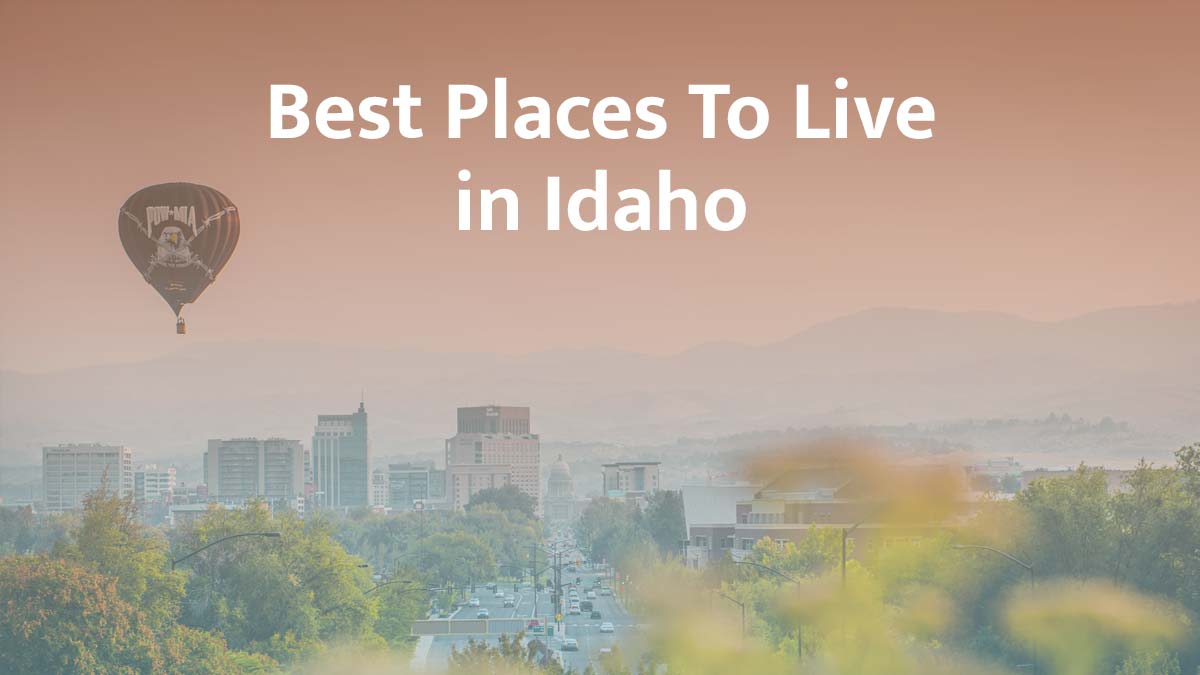
The best places to live in Idaho in 2026 include Boise, Meridian, Eagle, Nampa, Coeur d’Alene, Idaho Falls, Twin Falls, Pocatello, Moscow, and Caldwell.
Boise is our best overall choice because it offers the state’s strongest combination of jobs, amenities, and outdoor recreation. Meridian works well for suburban living, while Nampa and Caldwell provide lower-priced alternatives within the Treasure Valley. Idaho Falls and Pocatello stand out for buyers prioritizing affordability, while Coeur d’Alene offers one of Idaho’s most attractive lake and outdoor lifestyles.
Idaho’s overall price level remains below the national average, but that doesn’t mean every housing market is inexpensive. Current median listing prices range from about $386,000 in Pocatello to nearly $1 million in Eagle.
Key Takeaways
- Boise is our best overall place to live in Idaho for jobs, amenities, and outdoor access.
- Meridian offers suburban living near Boise, but its current home prices are slightly higher than Boise’s.
- Eagle and Coeur d’Alene are premium housing markets, with median listing prices near $1 million and $808,000, respectively.
- Pocatello and Idaho Falls offer some of the most attainable housing among our top 10.
- Idaho’s overall price level is about 4.5% below the U.S. average, but housing costs vary significantly by city.
- Idaho’s population has grown rapidly since 2020, contributing to development and housing demand.
Instant Valuation, Confidential Deals with a Certified iBuyer.com Specialist.
Sell Smart, Sell Fast, Get Sold. No Obligations.
Best Places to Live in ID
- Key Takeaways
- Why Idaho Is One of the Best States to Live In
- Key Factors to Consider Before Moving to Idaho
- 10 Best Places to Live in Idaho
- 1. Boise: Best Overall
- 2. Meridian: Best for Suburban Living
- 3. Eagle: Best for Upscale Suburban Living
- 4. Nampa: Best Boise-Area Value
- 5. Coeur d’Alene: Best for Lake and Outdoor Lifestyle
- 6. Idaho Falls: Best for Jobs and Value
- 7. Twin Falls: Best for Affordable Outdoor Living
- 8. Pocatello: Best for Affordability
- 9. Moscow: Best College Town
- 10. Caldwell: Best Emerging Treasure Valley Value
- Cost of Living in Idaho: What to Expect
- Best Places to Live in Idaho by Lifestyle
- Pros and Cons of Living in Idaho
- How to Choose the Best Place to Live in Idaho
- Frequently Asked Questions
- Final Thoughts on the Best Places to Live in Idaho
- Frequently Asked Questions
Why Idaho Is One of the Best States to Live In
Idaho’s biggest lifestyle advantage is access to the outdoors.
Mountains, lakes, rivers, forests, ski areas, hiking trails, fishing, camping, and mountain biking are accessible from communities throughout the state. Boise offers immediate access to the foothills and Boise River, while northern Idaho is known for its lakes and forests.
The state is also growing quickly. The U.S. Census Bureau estimated Idaho’s population at 2,029,733 in July 2025, up 10.4% from its April 2020 estimates base.
Employment opportunities include technology, healthcare, government, agriculture, food processing, advanced manufacturing, education, energy, and research.
Idaho also remains somewhat less expensive overall than the country as a whole. The latest Bureau of Economic Analysis regional price data gives Idaho a Regional Price Parity of 95.5, where the national average equals 100.
Housing is the important exception. Boise, Meridian, Eagle, Coeur d’Alene, Sandpoint, and McCall have become expensive markets, so affordability depends heavily on where you choose to live.
Key Factors to Consider Before Moving to Idaho
Housing Costs
Idaho is no longer a universally inexpensive housing market.
The current Idaho housing market has a statewide median listing price of approximately $602,700, with median asking rent around $2,095 per month.
The difference between cities is substantial.
Pocatello’s median listing price is about $386,000, compared with $625,000 in Boise, $640,000 in Meridian, $808,000 in Coeur d’Alene, and almost $1 million in Eagle.
Buyers should also budget beyond the purchase price. Current closing costs in Idaho typically include lender charges, title and escrow expenses, inspections, prepaid taxes, insurance, and other transaction costs.
Job Market
Idaho’s statewide unemployment rate was 3.6% in July 2026, according to current Bureau of Labor Statistics data.
The strongest industries depend on location.
Boise has the broadest employment base, including technology, government, healthcare, education, and professional services. Idaho Falls benefits from healthcare, engineering, research, and energy-related employment. Twin Falls has agriculture, food processing, healthcare, manufacturing, and logistics.
Moscow and Pocatello have significant university-related employment.
Taxes
Idaho has a flat 5.30% individual income tax rate and a 6.00% state sales tax.
The Tax Foundation’s Idaho profile reports an effective property tax rate of approximately 0.50% on owner-occupied housing value.
Actual property-tax bills depend on the property and local taxing districts, so buyers should compare specific homes rather than relying only on statewide rates.
Climate and Geography
Climate varies considerably across Idaho.
Southern Idaho generally has hot, dry summers and cold winters, while northern and mountain areas can receive substantially more snow.
Wildfire and smoke are also considerations in some regions during dry seasons.
Buyers looking at rural or mountain properties should consider road access, snow removal, wells, septic systems, wildfire exposure, and insurance in addition to the purchase price.
10 Best Places to Live in Idaho
| City | Best For | Median Listing Price | Main Tradeoff |
|---|---|---|---|
| Boise | Best overall | $624,750 | Housing has become expensive |
| Meridian | Suburban living | $639,945 | No longer a lower-cost Boise alternative |
| Eagle | Upscale suburban living | $996,800 | Near $1 million median asking price |
| Nampa | Boise-area value | $487,485 | Longer Boise commute |
| Coeur d’Alene | Lake + outdoor lifestyle | $807,500 | Expensive housing |
| Idaho Falls | Jobs + value | $429,225 | Smaller entertainment scene |
| Twin Falls | Outdoor living | $475,450 | Smaller employment market |
| Pocatello | Affordability | $386,225 | Fewer major employers |
| Moscow | College-town living | $535,000 | Specialized job market |
| Caldwell | Treasure Valley value | $458,800 | Farther from central Boise |
Prices are approximate 2026 median listing prices. Listing prices represent asking prices rather than completed sale prices and change over time.
1. Boise: Best Overall
Best for: Professionals, outdoor enthusiasts, and people who want more amenities
Boise is our best overall Idaho city because it offers the state’s broadest combination of employment, restaurants, entertainment, healthcare, education, and outdoor recreation.
The Boise River Greenbelt runs through the city, while the foothills provide nearby hiking and mountain biking. Residents also have access to skiing and other mountain recreation.
Boise’s job market includes technology, government, healthcare, education, and professional services.
The tradeoff is affordability. The current median listing price is approximately $624,750, meaning Boise is no longer the inexpensive Western city it was once considered.
Buyers purchasing an older property should also budget for due diligence. A standard home inspection in Idaho generally costs about $350 to $550, with additional testing potentially needed depending on the property.
2. Meridian: Best for Suburban Living
Best for: Buyers who want suburban living near Boise
Meridian has grown into one of the Treasure Valley’s largest suburban communities.
Residents have access to newer residential developments, shopping, parks, restaurants, healthcare, and Boise-area employment.
The current median listing price is approximately $639,945, slightly higher than Boise’s current median.
That is an important change from older descriptions of Meridian as an affordable alternative to Boise.
Meridian makes the most sense for buyers who specifically want a suburban environment and can comfortably afford current Treasure Valley prices.
3. Eagle: Best for Upscale Suburban Living
Best for: Higher-budget buyers seeking space and Boise access
Eagle provides a more upscale suburban environment northwest of Boise.
The community offers newer and luxury residential development, larger properties, Boise River access, trails, and convenient access to the broader Boise metro.
Housing is the biggest limitation.
The current median listing price is approximately $996,800, putting Eagle close to the $1 million level.
That makes Eagle better suited to higher-income households than buyers whose primary goal is affordability.
4. Nampa: Best Boise-Area Value
Best for: Buyers seeking lower housing prices within the Treasure Valley
Nampa provides one of the better compromises between Treasure Valley access and housing cost.
The current median listing price is approximately $487,485, substantially below Boise, Meridian, and Eagle.
Nampa’s economy includes healthcare, manufacturing, retail, agriculture-related industries, and other regional services. Residents can also commute toward Meridian and Boise for additional employment opportunities.
The tradeoff is location.
Rapid Treasure Valley growth has increased traffic, and commuting into Boise can add significant time to the day.
For buyers who want to remain in the Boise region without paying Boise or Meridian prices, Nampa deserves serious consideration.
5. Coeur d’Alene: Best for Lake and Outdoor Lifestyle
Best for: Outdoor enthusiasts and higher-budget households
Coeur d’Alene is one of Idaho’s strongest lifestyle destinations.
Lake Coeur d’Alene provides boating, swimming, fishing, and waterfront recreation, while surrounding mountains offer hiking, skiing, and other outdoor activities.
Downtown adds restaurants, shops, and tourism-oriented amenities. Spokane is also within reach for additional employment, shopping, and air travel.
The drawback is housing.
The current median listing price is approximately $807,500, significantly higher than older descriptions of Coeur d’Alene as a mid-priced Idaho market.
Seasonal tourism can also make the area considerably busier during peak periods.
6. Idaho Falls: Best for Jobs and Value
Best for: Buyers seeking career opportunities without Boise-area prices
Idaho Falls offers one of the strongest combinations of employment and housing value in the state.
The regional economy includes healthcare, engineering, research, energy, and employment connected to Idaho National Laboratory.
The current median listing price is approximately $429,225, considerably below Boise, Meridian, Eagle, and Coeur d’Alene.
Residents also have access to eastern Idaho recreation and are positioned for trips toward Yellowstone and Grand Teton National Parks.
The tradeoff is a smaller restaurant, entertainment, and cultural scene than Boise.
For people whose career fits the eastern Idaho economy, Idaho Falls can offer a particularly strong balance.
7. Twin Falls: Best for Affordable Outdoor Living
Best for: Outdoor enthusiasts who prefer a smaller city
Twin Falls combines relatively attainable housing with access to some of southern Idaho’s most recognizable scenery.
The Snake River Canyon, Perrine Bridge, and nearby Shoshone Falls provide immediate outdoor recreation.
The regional economy includes agriculture, food processing, healthcare, manufacturing, and logistics.
The current median listing price is approximately $475,450, making Twin Falls less expensive than Boise, Meridian, Eagle, and Coeur d’Alene.
Its main limitation is scale. The job market and entertainment options are smaller than Boise’s, although that may appeal to residents looking for a less urban environment.
8. Pocatello: Best for Affordability
Best for: Budget-conscious buyers and university-related households
Pocatello has the lowest median listing price among the 10 places in this guide.
The current median is approximately $386,225.
Idaho State University supports education-related employment, while healthcare and other regional services contribute to the local economy.
Residents also have convenient access to hiking, mountain recreation, and eastern Idaho destinations.
Pocatello’s tradeoff is its smaller job market. People working in specialized industries may have fewer options than they would in Boise or Idaho Falls.
For buyers prioritizing home affordability, however, Pocatello is one of the strongest choices on this list.
9. Moscow: Best College Town
Best for: Academics, university employees, and people seeking a college-town environment
Moscow is home to the University of Idaho and offers one of the state’s most distinctive college-town environments.
Its downtown has restaurants, shops, cultural activities, and community events, while the surrounding Palouse provides a very different landscape from southern Idaho.
Nearby Pullman, Washington, and Washington State University expand the region’s educational and employment environment.
Housing is more expensive than the city’s size might suggest.
The current median listing price is approximately $535,000.
The employment market is also more specialized, with education playing an outsized role compared with larger Idaho cities.
10. Caldwell: Best Emerging Treasure Valley Value
Best for: Buyers seeking lower prices in the broader Boise region
Caldwell is another option for buyers who want Treasure Valley access without paying Boise, Meridian, or Eagle prices.
The current median listing price is approximately $458,800.
The local economy includes agriculture, food production, education, manufacturing, and regional services. The College of Idaho is also located in Caldwell.
Continued residential development has expanded the area’s housing options as the Treasure Valley grows.
The main drawback is distance from Boise.
Households commuting regularly into central Boise should calculate transportation time and cost before choosing Caldwell purely for its lower purchase price.
Cost of Living in Idaho: What to Expect
Idaho remains somewhat less expensive overall than the national average, but housing is increasingly the exception.
The latest federal Regional Price Parity for Idaho is 95.5, with the national benchmark set at 100. That means the state’s overall price level was about 4.5% below the national average in the latest available dataset.
Current housing prices show why statewide averages need context:
| City | Approx. Median Listing Price |
|---|---|
| Eagle | $996,800 |
| Coeur d’Alene | $807,500 |
| Meridian | $639,945 |
| Boise | $624,750 |
| Moscow | $535,000 |
| Nampa | $487,485 |
| Twin Falls | $475,450 |
| Caldwell | $458,800 |
| Idaho Falls | $429,225 |
| Pocatello | $386,225 |
The statewide median listing price is approximately $602,700.
Taxes are another part of the calculation. Idaho’s individual income-tax rate is 5.30%, the state sales-tax rate is 6.00%, and its effective owner-occupied property-tax rate is relatively low compared with many states.
Buyers should still calculate the complete cost of a specific property, including mortgage payments, taxes, insurance, utilities, maintenance, HOA fees, and transportation.
Financed buyers should also expect a property valuation during the mortgage process. A standard home appraisal in Idaho currently costs roughly $700 to $800 for many single-family properties, with complex or rural assignments potentially costing more.
Best Places to Live in Idaho by Lifestyle
| Priority | Best Options |
|---|---|
| Best overall | Boise |
| Suburban living | Meridian, Eagle |
| Boise-area value | Nampa, Caldwell |
| More affordable housing | Pocatello, Idaho Falls |
| Outdoor lifestyle | Coeur d’Alene, Twin Falls |
| College-town lifestyle | Moscow |
| Career opportunities | Boise, Idaho Falls |
| Retirement | Coeur d’Alene, Twin Falls |
| Young professionals | Boise |
| Higher-end suburban living | Eagle |
Budget can quickly narrow the choices.
Buyers who want the Boise metro but cannot justify Boise or Meridian prices may find Nampa or Caldwell more realistic. Those who don’t need Treasure Valley access can find considerably lower median prices in Idaho Falls and Pocatello.
Outdoor-focused buyers with larger budgets may prefer Coeur d’Alene. Sandpoint and McCall are other attractive recreational destinations, but current median listing prices in both markets are substantially higher than Idaho’s statewide figure.
Pros and Cons of Living in Idaho
Pros
- Extensive outdoor recreation
- Growing economy and population
- Overall price level below the U.S. average
- Relatively low effective property-tax rate
- Strong employment options in Boise and several regional centers
- Wide variety of small-city and suburban lifestyles
- Mountains, rivers, lakes, and public lands
Cons
- Boise-area housing has become expensive
- Coeur d’Alene and resort markets carry premium prices
- Rapid Treasure Valley growth has increased traffic and development pressure
- Winters can be cold and snowy
- Wildfire smoke can affect some areas seasonally
- Rural areas may offer fewer healthcare and employment options
- Public transportation is limited in much of the state
How to Choose the Best Place to Live in Idaho
Start with your housing budget.
Buyers with larger budgets can consider Eagle, Coeur d’Alene, Boise, and Meridian. Those prioritizing lower home prices should look more closely at Pocatello, Idaho Falls, Caldwell, and Nampa.
Next, consider your career.
Boise has the broadest employment base. Idaho Falls stands out for energy, engineering, research, and healthcare. Moscow and Pocatello have university-related opportunities, while Twin Falls and the western Treasure Valley have strong ties to agriculture, food production, healthcare, and manufacturing.
Then decide how much city life you want.
Boise offers the most extensive amenities. Meridian and Eagle provide suburban alternatives. Idaho Falls, Twin Falls, and Pocatello offer smaller-city environments, while Moscow has a distinctive college-town atmosphere.
Outdoor priorities matter too. Coeur d’Alene is particularly attractive for lake recreation, Boise provides easy foothills and river access, and Twin Falls is ideal for people drawn to the Snake River Canyon.
Finally, calculate the complete cost of living in each location, not just the purchase price.
If you already own a home and are considering relocating, iBuyer’s guide to selling a house in Idaho explains the current process and selling options. Homeowners prioritizing speed can also compare cash home buyers in Idaho or explore selling a property as-is.
Frequently Asked Questions
Final Thoughts on the Best Places to Live in Idaho
The best place to live in Idaho depends on how you balance housing costs, employment, outdoor access, and lifestyle.
Boise provides the strongest overall combination of jobs and amenities, while Meridian offers a more suburban environment. Eagle caters to higher-budget buyers, and Nampa and Caldwell provide lower-priced Treasure Valley alternatives.
In northern Idaho, Coeur d’Alene stands out for lake and mountain recreation but comes with premium housing prices. Idaho Falls offers a particularly strong combination of employment and value, while Twin Falls and Pocatello provide more attainable alternatives. Moscow is the most distinctive choice for a college-town lifestyle.
Idaho remains less expensive than the national average on an overall price-level basis, but today’s housing market is very different from the inexpensive Idaho of older relocation guides.
Compare the specific city’s housing costs, jobs, climate, taxes, and lifestyle before deciding where to move.
Frequently Asked Questions
Boise is our best overall choice because it offers Idaho’s broadest combination of employment, restaurants, healthcare, entertainment, and outdoor recreation. Its current median listing price is approximately $624,750.
Pocatello has the lowest current median listing price among our top 10 at approximately $386,225. Idaho Falls is another relatively attainable option at about $429,225.
Yes. Boise combines a diverse job market, restaurants, healthcare, education, the Boise River Greenbelt, and easy access to outdoor recreation. The main drawback is housing cost, with a current median listing price of approximately $624,750.
Meridian is a strong choice for people who want suburban living with access to Boise-area employment, shopping, healthcare, and recreation. However, its median listing price is now approximately $639,945, slightly above Boise’s.
Idaho’s overall price level is about 4.5% below the U.S. average according to the latest federal Regional Price Parity data, but housing affordability varies widely. Boise, Meridian, Eagle, and Coeur d’Alene are considerably more expensive than Pocatello or Idaho Falls.
Meridian, Eagle, Nampa, and Boise are worth considering for households seeking suburban or city amenities. The best choice depends on housing budget, employment, commute, recreation, and the specific schools or services important to your household.
Boise is the strongest overall choice for young professionals because it has Idaho’s broadest employment base, restaurants, entertainment, and outdoor recreation. Moscow can also appeal to people working in education or seeking a college-town environment.
Coeur d’Alene and Twin Falls are worth considering for retirees who prioritize outdoor recreation and a smaller-city lifestyle. Housing budget, healthcare access, winter conditions, and proximity to family should also factor into the decision.
Boise offers Idaho’s broadest mix of employment across technology, healthcare, government, education, and professional services. Idaho Falls is particularly strong for people working in healthcare, engineering, research, and energy-related fields.
Idaho’s effective property tax rate on owner-occupied housing value is approximately 0.50% according to Tax Foundation’s 2026 state profile. Actual property-tax bills vary by home value, location, exemptions, and local taxing districts.
It can be if Idaho’s outdoor lifestyle, employment opportunities, smaller cities, and tax structure fit your priorities. Compare current housing prices, jobs, climate, healthcare, commuting, and the complete cost of living before choosing a city.

Reilly Dzurick is a licensed real estate agent with over six years of experience and a member of the iBuyer.com Market Insights Team, covering national trends in home selling and the evolving iBuyer landscape. Her firsthand experience working with buyers and sellers gives her a practical perspective on how these platforms impact real homeowners. She holds a degree in Public Relations, Advertising, and Applied Communication.