Get future investor reports for your market
We publish monthly and quarterly data across U.S. metros. Select your market and role and we will send new reports directly to your inbox.

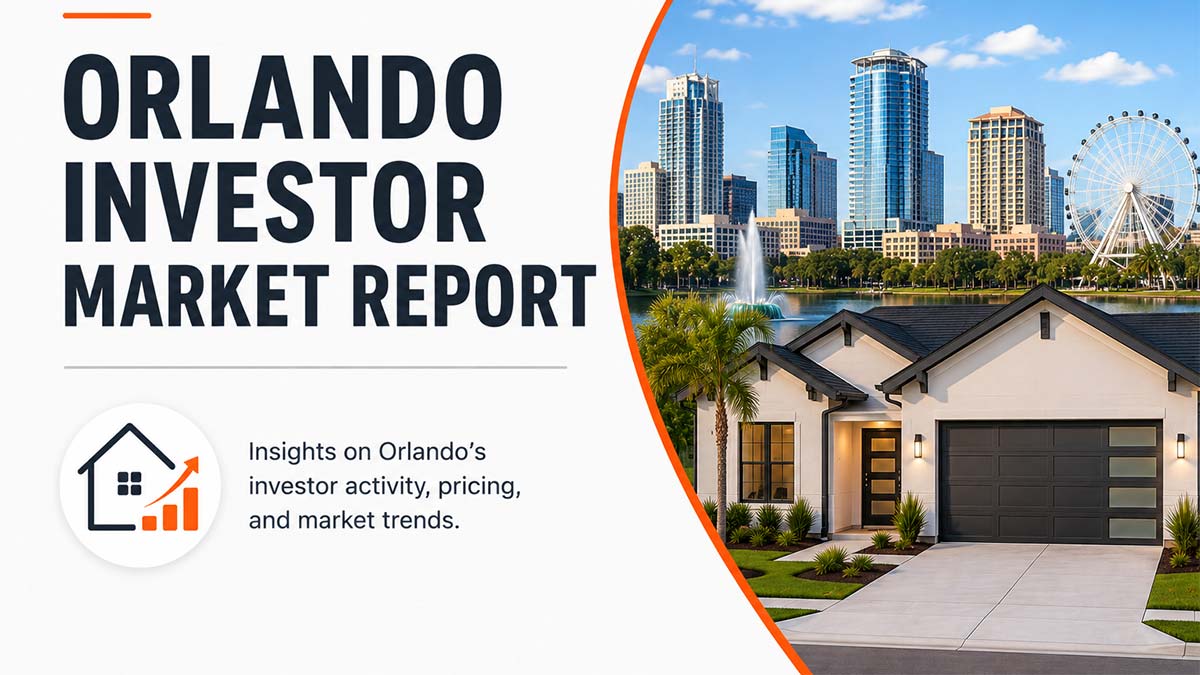
Corporate and LLC-based entities hold 30.8% of the 9,659 single-family residential properties tracked across the Orlando metro from January through May 2026. The market’s defining characteristic is not its corporate rate, which is mid-range for this series, but its value concentration: 42.7% of all tracked acquisitions fall in the $250k-$400k tier, the highest single-tier share recorded across the fifteen-market five-month series. Orlando is not an affordable-stock play like Memphis or Kansas City. National and institutional SFR operators are deploying capital here at scale, targeting newer construction in the $300k-$400k range where rental yields and tenant quality align with institutional underwriting standards.
The top buyer list confirms that orientation. Alto Asset Company 6 LLC leads with 116 properties, its largest position in the series. Opendoor Property Trust I holds 77, SFR XII Orlando Owner 1 LP holds 64, and Tricon SFR 2026 1 Borrower LLC holds 54. Three of those four are recognized national platforms with multi-market footprints. This is one of the few markets in the series where national operators dominate the top buyer positions without a local LLC or regional operator in the mix.
Data sourced and verified by the iBuyer.com Market Insights Team. Coverage period: January 1 through May 31, 2026.
30.8%
Corporate / LLCOwnership Rate
9,659
PropertiesAnalyzed
$376,000
MedianMarket Value
63.2%
CashBuyer Rate
16.6%
Out-of-StateInvestor Share
8,483
Unique InvestorEntities
Thinking About Selling in Orlando?
With 63.2% of tracked buyers paying cash, there is a deep and active investor pool for your property. Find out what it is worth today.
Corporate Ownership Rate
Corporate and LLC-based entities account for 2,976 of the 9,659 tracked SFR properties in Orlando, a 30.8% corporate rate that places the metro in the mid-range of this series, above Austin (26.8%) and Las Vegas (28.3%) but below the high-concentration markets like Atlanta (52.8%) and Kansas City (48.7%). The corporate side of the buyer pool is served by 3,503 unique corporate entities, averaging less than one property per entity across the full corporate subset. That fragmentation is somewhat misleading here, however, because the top buyer positions are occupied by national platforms with triple-digit holdings rather than the local one-to-three-property LLCs that define fragmented markets like Oklahoma City or New Orleans.
Alto Asset Company 6 LLC leads at 116 properties, marking the entity’s largest single-market position in the series and its fifth series market (previously tracked in Austin, Dallas, Indianapolis, and Jacksonville, where its prior record was 111 properties). Opendoor Property Trust I holds 77, appearing in Orlando as it has across Jacksonville, Las Vegas, Nashville, Dallas, and multiple other series markets. SFR XII Orlando Owner 1 LP holds 64 in its first series appearance, likely a structured SFR fund vehicle with a Florida-specific acquisition mandate. Tricon SFR 2026 1 Borrower LLC rounds out the top four at 54, its fifth series market after Atlanta, Charlotte, Dallas, and Jacksonville.
“What we’re seeing here is a tale of two investment strategies playing out in Orlando’s single-family rental market. While corporate ownership sits at 31% across 9,659 properties, the concentration tells the real story: Alto Asset Company 6 LLC alone controls 116 properties, and Opendoor Property Trust I holds 77. These institutional players are building rental positions in specific submarkets like zip 34747, where corporate ownership reaches 48% of investor activity. The cash-heavy nature of this market, 63% cash buyers, signals these are not speculative flips but calculated rental yield plays targeting Orlando’s robust tourism and population growth. For this institutional dominance to ease, we would need either a significant shift in cap rates that makes other asset classes more attractive, or a meaningful expansion of new construction supply that reduces the scarcity premium driving these concentrated acquisition strategies.” iBuyer.com Market Insights, Orlando Analysis, June 2026
Where Investors Are Buying
Investor activity spans 25 zip codes, with the top zip, 34747 (Kissimmee/Four Corners area), holding 423 properties at a 4.4% share. The top ten zips account for roughly 30% of all tracked activity, leaving 70% distributed across 15 additional zips, a relatively even spread given the metro’s geographic breadth across Orange, Osceola, Seminole, and Lake counties. The zip concentration chart is more dispersed than markets like Memphis (where the top zip holds 10.5%) or Kansas City (7.1%), consistent with a large, geographically diverse metro where institutional demand is broad-based rather than corridor-specific.
The value profile across the top ten reveals a clear bifurcation. Zips 34747 and 34787 carry average values of $520k and $571k respectively, well above the $376k median, pointing to institutional acquisition of newer, premium-rental-grade stock in high-demand Kissimmee resort corridors and Winter Garden master-planned communities. At the other end, 32808 (Pine Hills/Northwest Orlando) averages $262k and 34748 (Leesburg) averages $277k, reflecting a secondary layer of more affordable acquisition activity. Per this dataset’s zip-level figures, 34747 shows corporate buyers at approximately 48% of transactions, the highest in the top ten, with Alto Asset Company 6 LLC and Opendoor among the most active entities there. Zip 34787 carries a $571k average, the highest in the top ten, but its out-of-state share is notably lower at approximately 16%, suggesting primarily Florida-based institutional capital targeting Winter Garden’s growth corridor.
| # | Zip Code | Neighborhood | Properties | Share | Avg Value |
|---|---|---|---|---|---|
| 1 | 34747 | Kissimmee / Four Corners | 423 | 4.4% | $520,000 |
| 2 | 34787 | Winter Garden | 337 | 3.5% | $571,000 |
| 3 | 34746 | Kissimmee (West) | 307 | 3.2% | $409,700 |
| 4 | 34759 | Poinciana | 269 | 2.8% | $280,000 |
| 5 | 34748 | Leesburg | 244 | 2.5% | $277,500 |
| 6 | 34711 | Clermont | 227 | 2.4% | $395,000 |
| 7 | 32771 | Sanford | 217 | 2.2% | $317,000 |
| 8 | 32725 | Deltona | 195 | 2.0% | $296,000 |
| 9 | 32808 | Pine Hills / NW Orlando | 195 | 2.0% | $262,000 |
| 10 | 34762 | Okahumpka / Leesburg SW | 188 | 1.9% | $423,500 |
The geographic reach is notable. The top ten spans four counties and five distinct market types: Osceola County resort-adjacent corridors (34747, 34746), Orange County established neighborhoods (32808), Lake County growth communities (34711, 34748, 34759, 34762), Seminole County suburban stock (32771), and the Volusia fringe (32725). That county diversity reflects institutional underwriting of metro-wide demand rather than a single-submarket thesis, and makes Orlando’s corporate investor footprint harder to displace with a single zoning or supply shock than a more corridor-concentrated market like Memphis or Kansas City.
Price Tiers
The $250k-$400k tier captures 42.7% of all tracked investor activity in Orlando, a concentration that sets a new series high and is a defining feature of this market. No other metro in the five-month series comes close to this level of mid-market concentration in a single tier. Orlando’s nonfarm employment base of approximately 1.4 million jobs, anchored by tourism, hospitality, healthcare, and technology, per the Bureau of Labor Statistics Orlando-Kissimmee-Sanford Economy at a Glance, produces a large middle-income workforce that sustains consistent demand for well-maintained SFR rentals in the $2,000-$2,500 monthly range, which maps directly to the $300k-$400k acquisition tier at prevailing cap rates.
The $376,000 median market value in this dataset aligns more closely with the active-listing median tracked by the FRED Orlando-Kissimmee-Sanford median listing price series (MEDLISPRI36740) than in more affordable series markets, where a wide gap between investor-held stock and the full active market is typical. That alignment reflects the institutional strategy here: buying properties that are representative of the mid-market, not distressed outliers. The average market value of $474,183 produces a mean-to-median spread of roughly 26%, moderate for the series and consistent with a market where some high-value Kissimmee resort properties in the top ten zips pull the average above the median without dramatically skewing it.
Housing Stock
The median year built is 1992 and only 22.2% of tracked properties were built before 1970, making Orlando one of the newest housing stock markets in the series alongside Las Vegas (7.4% pre-1970, median 2000). Orlando’s modern profile is structural: the metro did not develop at meaningful scale until the 1970s Disney-driven expansion, so the pool of pre-war and early postwar stock that dominates Midwest markets simply does not exist here. The 2000s is the single largest build decade at 19.5% (approximately 1,856 properties), reflecting the surge of master-planned community construction in Orange, Osceola, and Lake counties during the early 2000s housing boom.
Median year built: 1992. Pre-1970 share: 22.2% of tracked properties. The Orange County Property Appraiser’s Office (OCPAFL) determines assessed market value for properties in Orange County under Florida’s annual reassessment cycle. Florida law requires annual reassessment at just (market) value; the Save Our Homes cap limits assessment increases for homesteaded properties but does not apply to investor-held properties, which are reassessed to full market value each year. Market values in this dataset reflect assessed market value at time of Lumentum export.
Full Market Snapshot
| Metric | Value | Signal | Notes |
|---|---|---|---|
| Properties analyzed | 9,659 | Baseline | Large dataset; fourth-largest in series after Dallas, Houston, Atlanta |
| Corporate ownership rate | 30.8% | Mid | 2,976 of 9,659 via LLC / trust / entity |
| Out-of-state investor share | 16.6% | Mid | 1,605 of 9,659 mailing outside state; mid-range in series |
| Median market value | $376,000 | Mid-tier | Above series median; fourth-highest after Miami $620k, Denver $595k, Nashville $408k |
| Average market value | $474,183 | Reference | Mean-to-median spread ~26% |
| Cash buyer rate | 63.2% | High | 6,103 of 9,659; mid-range in series |
| Median property size | 1,700 sq ft | Reference | Above series median; consistent with 2000s-built suburban product |
| Built pre-1970 | 22.2% | Newer stock | Median year built 1992; 2000s is peak decade at 19.5% |
| Unique corporate entities | 8,483 | Fragmented | Includes all investor types; 3,503 are corporate entities |
| Active zip codes | 25 | Broad | Activity spans Orange, Osceola, Seminole, Lake, and Volusia counties |
Who Is Buying
With 8,483 unique entities across 9,659 tracked properties, Orlando has the second-largest buyer pool in the series by entity count after Miami (12,933), reflecting the metro’s scale and the depth of investor demand across price tiers. The corporate subset of 3,503 entities controls 2,976 properties, again producing a near-1:1 fragmentation ratio. But unlike Oklahoma City or New Orleans, where that ratio means the top buyer holds 34 or 9 properties, Orlando’s top four are institutional operators with triple-digit positions and national presence.
| Rank | Entity | Properties | Profile |
|---|---|---|---|
| 1 | Alto Asset Company 6 LLC | 116 | Multi-market yield operator; largest position in series across five markets |
| 2 | Opendoor Property Trust I | 77 | iBuyer platform; multi-market series presence; named, not linked |
| 3 | SFR XII Orlando Owner 1 LP | 64 | Structured SFR fund vehicle; first series appearance; Florida-specific mandate |
| 4 | Tricon SFR 2026 1 Borrower LLC | 54 | Institutional SFR borrower; fifth series market (also Atlanta, Charlotte, Dallas, Jacksonville) |
Alto Asset Company 6 LLC’s 116-property position here sets a new series record for the entity, surpassing its 111-property lead in Jacksonville. Its multi-market footprint, now spanning Austin, Dallas, Indianapolis, Jacksonville, and Orlando, follows a consistent pattern: mid-size Sunbelt metros with strong rental demand and limited supply of newer SFR stock. The concentration in 34747 and adjacent Osceola County zips suggests Alto is building a geographically coherent sub-portfolio in the Kissimmee resort-to-residential corridor, where short-term rental conversion potential adds a yield optionality layer to long-term hold positions.
SFR XII Orlando Owner 1 LP represents the most operationally significant new entity in this report. The “XII” designation indicates a numbered fund series, typically associated with an institutional asset manager raising successive SFR-focused vehicles. Its 64-property first appearance, concentrated in a single metro under a market-specific name, is a pattern consistent with a dedicated Florida SFR vehicle rather than a national operator’s sub-entity. Its full identity warrants tracking in subsequent data pulls to determine whether it expands to additional Florida markets or remains Orlando-focused.
Sell Your Orlando Home to a Cash Buyer
Institutional and local investors are actively acquiring across all 25 tracked zip codes. See what your property is worth in today’s market.
Market Implications
- Price in the $250k-$400k range to access 42.7% of corporate demand; that tier moved 4,126 tracked properties
- In 34747 and 34787, corporate buyers pay $520k-$571k averages; premium stock commands premium prices
- Target cash buyers; 63.2% of tracked investors skip financing contingencies and close faster
- 2000s-built homes (19.5% of investor stock) draw active institutional demand from Alto, Tricon, and similar operators
- Warn buyers that 34747 has corporate competition at approximately 48% of transactions; coach on proof-of-funds speed
- Steer seller clients toward 34787 ($571k avg) and 34747 ($520k avg) where institutional demand is strongest
- Target 34711 and 34762 ($395k-$424k avg) for buyer clients where corporate presence is lower than top zips
- The $400k-$600k tier (27.0% of market) still sees strong investor activity; pre-qualify buyers well above asking
- Avoid 34747 where corporate competition peaks at ~48% and Alto Asset Company 6 LLC owns 116 properties
- Target 34711 (Clermont, $395k avg) and 34762 ($424k avg) where corporate presence is lower
- Bring cash or equivalent speed; 63.2% of tracked buyers in this market close without financing
- Pre-1980s stock (below 22.2% of investor holdings) sees less institutional competition than 2000s-built product
Reading the Signals
Q1 Through Q2: Institutional Capital Accelerating Into Peak Season
Orlando is one of the few markets in this series where the Q1-to-Q2 trajectory matters in a directional sense. National SFR platforms like Alto, Opendoor, and Tricon operate with capital deployment schedules tied to fund mandates and acquisition targets, and they typically increase activity in Q2 as spring market liquidity improves and more inventory becomes available. The 42.7% concentration in the $250k-$400k tier and the 63.2% cash rate are structural features of institutional acquisition, not seasonal spikes, but the pace of institutional buying is more likely to accelerate heading into summer than to flatten. A market where the top four buyers collectively hold 311 properties at a $474k average is a market where institutional demand is deepening heading into peak season, not pulling back. Sellers with properties in the $300k-$450k range are entering the strongest institutional demand window of the year.
The $250k-$400k Record: What It Means for Sellers and Buyers
The 42.7% single-tier concentration in the $250k-$400k range is the highest in the five-month series, surpassing Dallas’s $250k-$400k dominance at 39.3%. That record is not coincidental; it reflects the specific intersection of Orlando’s median household income, the rental affordability ceiling for its service-economy workforce, and the acquisition math of institutional SFR operators targeting 5-6% cap rates on properties in the $300k-$380k range. For sellers in that tier, the corporate demand pipeline is the deepest and most competitive in the metro. For buyers, it is also the most difficult tier to compete in, with cash institutional buyers setting the pace on timelines and contingency terms. The implication heading into summer is that properties entering the market in the $300k-$400k range will face the most intense corporate competition in the series.
SFR XII and the Structured Vehicle Signal
The appearance of SFR XII Orlando Owner 1 LP as a 64-property first-series entrant warrants specific attention. Structured SFR vehicles with numbered series names, like Star 2022 SFR3 Borrower LP (which appeared in Las Vegas) and FKH SFR Q LP and R LP across multiple markets, typically signal an institutional asset manager raising successive funds as earlier vehicles deploy their capital. The “XII” designation, if sequential, implies at least eleven prior vehicles, suggesting a seasoned operator with significant AUM in the SFR space. The Orlando-specific name signals either a dedicated Florida fund or a sub-allocation of a larger vehicle to a single market. If additional named SFR XII entities appear in Tampa, Jacksonville, or Miami in future data pulls, they would indicate a Florida-focused SFR fund in active deployment, a development that would meaningfully shift the national platform presence in Florida’s major markets.
Frequently Asked Questions
Methodology
Data sourced and verified by the iBuyer.com Market Insights Team. Coverage period: January 1 through May 31, 2026.
Ready to Sell Your Orlando Home?
Connect with cash buyers across all 25 tracked zip codes. No repairs, no contingencies, no waiting on lenders.

Reilly Dzurick is a licensed real estate agent with over six years of experience and a member of the iBuyer.com Market Insights Team, covering national trends in home selling and the evolving iBuyer landscape. Her firsthand experience working with buyers and sellers gives her a practical perspective on how these platforms impact real homeowners. She holds a degree in Public Relations, Advertising, and Applied Communication.